

Review · MADRID
Tour en tuk-tuk electrico por MADRID MODERNO
Madrid is spread out, and this 90-minute electric tuk-tuk tour gives you a quick look at its grandest sights without wearing out your shoes. You will pass royal buildings, famous museums, grand boulevards, historic gates, and Salamanca’s luxury streets while your guide explains what you are seeing.
I like the efficient route and the private format. You can stop for photos, hear brief stories at each monument, and ask your own questions instead of following a large group. I also like that guides such as Juan, Javier, Jimena, José, and George have earned praise for clear English, good local advice, and a friendly manner.
The main caution is reliability. Several bookings had problems with the driver not arriving, and one delayed pickup involved confusion over the meeting point. Madrid traffic can also drown out the guide, so confirm the start details carefully and treat this as an overview, not a substitute for visiting the museums and palaces inside.
Key points at a glance
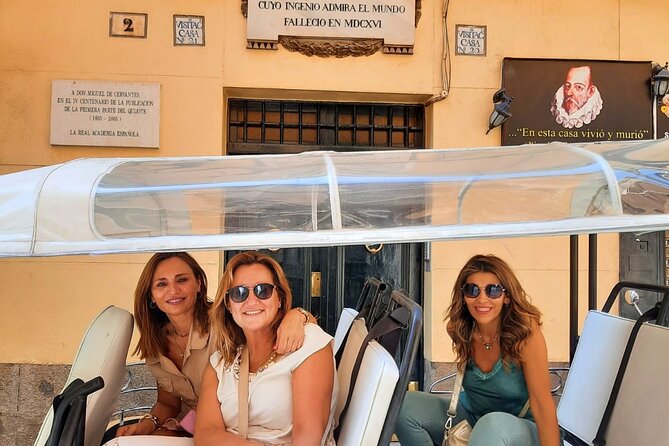
- A private route for up to four people: The $131.54 group price can offer fair value when shared by a small party.
- Major sights in a short time: The route links the Royal Palace, Almudena Cathedral, Atocha, the Prado area, Puerta de Alcalá, Salamanca, Cibeles, and Gran Vía.
- English-speaking guides: Juan, Javier, Jimena, José, and George are among the guides praised for useful commentary and pleasant service.
- Photo stops rather than full visits: You receive short explanations and can pause for pictures, but attraction admission is not part of the tour.
- A good first look at Madrid: The ride helps you decide which museums, plazas, and neighborhoods deserve more of your own time.
- Check the meeting plan: The listed start is 9:00 a.m. at C. de Vergara 1, with the tour returning there.
Seeing Madrid’s big sights without a long march
The clever part of this tour is its coverage. In an hour and a half, you move from the royal center to the Prado district, then toward Salamanca and the city’s famous central avenues. On foot, that same route would take much longer and leave less time for stopping to look up.
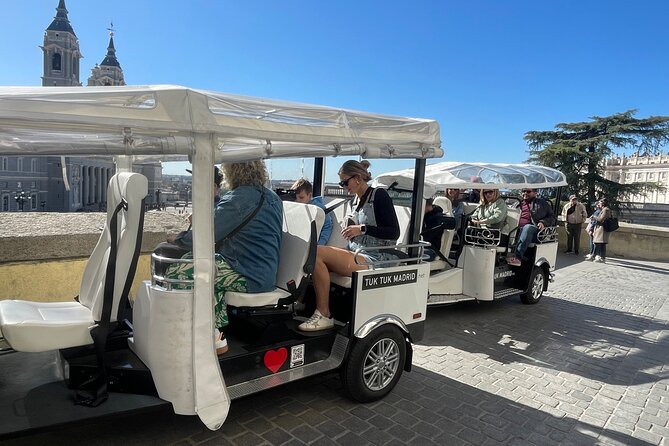
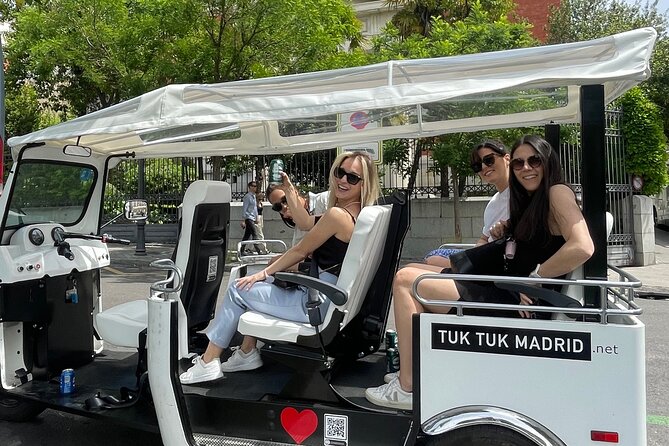
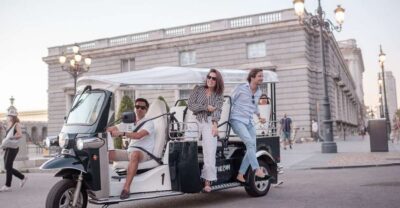
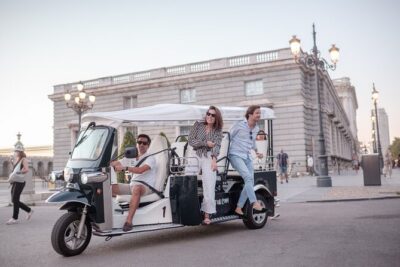
An electric tuk-tuk also gives you a more open view than a standard car. You are close to the street, buildings, fountains, and passing city life. The tradeoff is exposure to traffic noise. One practical complaint concerned the audio system, with street sounds making the guide hard to hear, so sit close to the guide and ask for a repeat when needed.
This is a private activity, so only your party takes part. That matters if you want to pause for a picture, ask about a restaurant, or spend a little extra time on a place that catches your eye. The vehicle is listed for groups of up to four, making the price much more attractive when divided among three or four people.
The tour includes bottled water and a guide-driver. Tips are not included. It is offered in English, and service animals are allowed. Most people can participate, although the ride is dependent on suitable weather.
A few more rides around Madrid worth a look
- Madrid: Private City Tour by Eco Tuk Tuk
★ 4.9 · 3,465 reviews - Madrid Welcome Tour with Local Guide in Eco Tuk Tuk Private
★ 5.0 · 2,936 reviews - Madrid Historical Tour with Local Guide in Eco Tuk Tuk Private
★ 5.0 · 876 reviews
Royal Madrid begins at the Palace and Almudena Cathedral
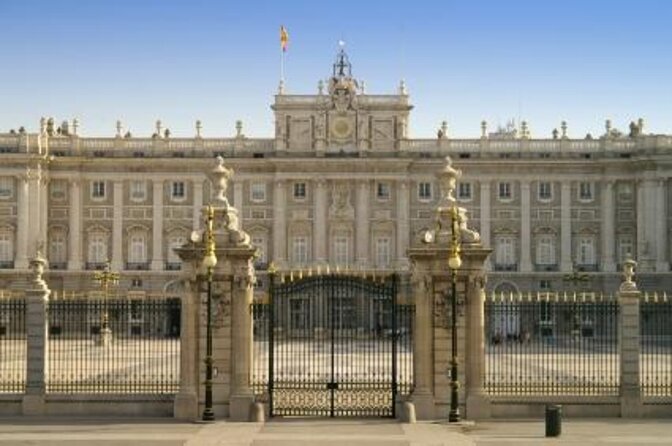
The meeting point is at C. de Vergara 1 in the city center, with a listed start time of 9:00 a.m. From there, the first major sight is the Royal Palace of Madrid, also called the Palace of the East.
This is not a modest royal residence. The palace covers about 135,000 square meters and contains 3,418 rooms, making it the largest royal palace in Western Europe by area. Your guide gives you an introduction from outside, which is useful for getting the basic story and understanding the building’s scale.
Do not expect palace admission during this ride. The point here is orientation and a good exterior view. If you want the grand rooms, collections, and interior details, you will need to plan a separate visit.
Nearby, the tuk-tuk reaches the Almudena Cathedral, Madrid’s principal Catholic church and the seat of the city’s archbishop. Its name comes from the Arabic al-mudayna, meaning citadel, and the cathedral occupies a site connected with Madrid’s earlier Islamic past.
The building is especially interesting because it combines several styles. The exterior is neoclassical, the interior is neo-Gothic, and the crypt is neo-Romanesque. Construction ran from the late 19th century into the late 20th century, so this is not one single-period monument. A short stop gives you a useful introduction, but you will want extra time if architecture or religious art is a priority.
The Royal Basilica of San Francisco el Grande follows as another impressive church in the historic center. It presides over the western side of Plaza de San Francisco and forms part of a former Franciscan convent. Its position near Bailén and Carrera de San Francisco makes it an easy sight to appreciate from the vehicle.
These first stops give the ride a clear theme: Madrid’s royal power, religious institutions, and older city center. I find this part most useful early in a visit, when you need a mental map before choosing where to return on foot.
Gates, fountains, and Madrid’s railway heart
The Toledo Gate offers a change of mood. This 19th-century triumphal arch was designed by Spanish architect Antonio Aguado and built in honor of Ferdinand VII after the French occupation. It is located in the middle of the Glorieta de la Puerta de Toledo, so the tuk-tuk gives you an easy view without requiring a long walk around a traffic-heavy roundabout.
The route then reaches the Neptune Fountain, one of Madrid’s grand neoclassical monuments. It was proposed in 1777, completed in 1786, and originally placed along the Carrera de San Jerónimo facing the Cibeles Fountain. Its later move to the center of Plaza de Cánovas del Castillo helps explain why Madrid’s fountains often feel like carefully placed pieces in a larger city design.
At Atocha Station, you see one of the country’s most important railway complexes. It began as a simple stop in 1851 and later developed into the larger station opened in 1892. The area is an important transport junction and a useful reference point for the city’s southern and museum districts.
Atocha also places you near the Reina Sofía Museum, housed in the former General Hospital of Madrid. The original neoclassical structure was designed by José de Hermosilla and continued by Francesco Sabatini. The museum opened as a formal institution in 1992, later adding the Nouvel building in 2005.
The Reina Sofía is the place to return if you want 20th-century and contemporary Spanish art. The tuk-tuk gives you the building and its setting, but it does not provide museum entry or the time needed to see its collections properly.
The Prado district and the old Buen Retiro court
One of the most rewarding stretches passes the former monastery of San Jerónimo el Real, commonly called Los Jerónimos. This monastery once ranked among Madrid’s important religious houses and stood beside the royal rooms that grew into the Buen Retiro Palace under Philip IV.
Nearby, the Casón del Buen Retiro is one of the few surviving buildings from that palace complex. Built by Alonso Carbonel in 1637, it originally served as a court ballroom. Its later connection with the Prado Museum makes it part of Madrid’s long shift from royal court to public culture.
The history here comes with an unusual footnote. The Casón once held 19th-century paintings and, for a time, Pablo Picasso’s Guernica. That famous painting moved to the Reina Sofía in 1992. The Casón reopened in 2009 as a Museum Study Center after major work, while many 19th-century paintings moved to the Prado’s main building.
The Salón de Reinos is another surviving part of the Buen Retiro complex. It was built between 1630 and 1635 and served as the palace’s main representative hall. Its name refers to the coats of arms of the 24 kingdoms in the Hispanic Monarchy under Philip IV. It was later known as the Army Museum until the collections began moving to Toledo in 2005.
The tour also passes the Royal Spanish Academy, founded in 1713 on the initiative of Juan Manuel Fernández Pacheco, Marquis of Villena and Duke of Escalona. The academy works with 23 other Spanish-language academies through the Association of Spanish Language Academies.
At the Prado Museum, your guide can explain why the institution matters even if you do not go inside. The Prado is especially strong in Spanish and European painting from the 15th through the 18th centuries, with major works by Velázquez, El Greco, Goya, Titian, Rubens, and Bosch.
The stop here is short, listed at about five minutes, so think of it as a preview. I would use the guide’s comments to decide how to plan a later museum visit. Trying to see the Prado during this tuk-tuk outing would miss the point. The museum deserves several focused hours, not a hurried dash.
Same streets, a different route:
- Madrid Express Tour with Local Guide in Eco Tuk Tuk Private
★ 5.0 · 413 reviews - Madrid: Highlights City Tour by Electric Tuk Tuk
★ 4.7 · 346 reviews - Madrid: City Highlights Tuk Tuk Tour
★ 4.4 · 334 reviews - Madrid: City Tours – 6 seats private ecological tuk tuk
★ 4.6 · 230 reviews
Puerta de Alcalá, Las Ventas, and Salamanca
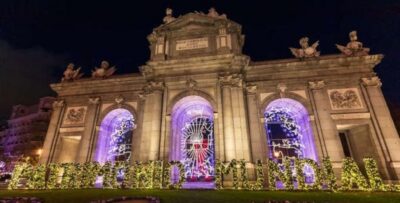
The Puerta de Alcalá is one of Madrid’s old royal entrance gates and now sits in the center of Plaza de la Independencia. It is close to the Retiro entrances and the streets of Alcalá, Serrano, Alfonso XII, and Salustiano Olózaga.
This is one of the tour’s best photo stops because the gate is framed by a large roundabout and several important city routes. You can photograph it quickly, then return later on foot to combine it with Retiro Park.
The ride continues to Las Ventas, Madrid’s largest bullring. Its capacity is listed at 23,798 people, and its ring measures 61.5 meters across. You see the exterior and receive context about its place in Spanish culture. Entry is not part of the experience, so plan a separate visit if you want to explore the building.
Then comes the Salamanca district, one of Madrid’s most polished areas. It was promoted and partly built in the 19th century by José de Salamanca y Mayol, the Marquis of Salamanca. Today, streets such as Serrano, Claudio Coello, and Ortega y Gasset form one of the city’s main luxury shopping zones.
The listed stop lasts about 20 minutes, making it the longest named pause on the route. That gives you a little more time to look around and notice the contrast with the historic center. The area is not a rough-edged neighborhood experience. It is orderly, expensive, and focused on high-end shops, grand apartment buildings, and city life at a high standard.
Cibeles, the National Library, and Gran Vía
The route returns toward the central boulevards at Plaza de Colón, named for Christopher Columbus. Streets including Goya, Génova, Serrano, and the Paseos de Recoletos and Castellana meet here. The plaza includes a neo-Gothic Columbus monument built between 1881 and 1885.
Nearby is the National Library of Spain, an important guardian of the country’s printed and documentary record. It holds about 30 million publications, including books, magazines, maps, engravings, drawings, scores, and pamphlets produced in Spain since the early 18th century.
The Cibeles Fountain is one of Madrid’s signature images. It was created as part of Carlos III’s 18th-century plan to improve the capital according to neoclassical ideas. The same plan connected the fountain with the Prado area, the Botanical Garden, and other civic projects.
Cibeles is also tied to local football celebrations, though the tour description focuses on its design and urban setting. The neighboring Bank of Spain occupies a major building at the junction of Calle Alcalá and Paseo del Prado. Its main headquarters was built between 1884 and 1891.
The final major sight is Gran Vía, Madrid’s famous commercial and entertainment artery. It begins at Calle de Alcalá and ends at Plaza de España. The stretch between Callao and Plaza de España is often compared with Broadway because of its theaters and musical productions, while the area around the San Luis network and Callao is known for international fashion chains.
The ride ends back at the starting point. That return is useful because you can then begin a walking route from a familiar central location, armed with a list of places worth a closer look.
What the $131.54 price really buys you
The price is $131.54 per group of up to four, not per person. For four people, that works out to roughly $33 per person before any tip. For two people, the per-person cost is much higher, but you still receive a private vehicle, a driver-guide, bottled water, and a route that covers far more ground than a casual walk.
The value depends on your priorities. If you want interior access to the Royal Palace, Prado, Reina Sofía, or Las Ventas, this is not the right product by itself. If you want a fast orientation, exterior views, and a private guide who can help you choose what to visit next, the price is easier to justify.
The 90-minute duration keeps the cost and commitment manageable. It also means the commentary at each sight must be brief. I would not book this expecting long historical talks. The strongest use is to get your bearings at the start of a Madrid stay, then return to two or three places that interest you.
Guides, timing, and the small practical details
Several guides receive specific praise. Juan is described as fun and clear in English. Jimena is praised for patience and a warm manner. Javier is noted for strong knowledge of Madrid and Spain, while José and Javier are credited with courteous service and useful restaurant suggestions. Another ride with Javier and George worked well for an English and Spanish-speaking family group.
That suggests the quality of the experience depends heavily on the guide assigned. A good guide turns a string of monuments into a connected story. A poor communication setup, or a noisy traffic stretch, can make even a good route harder to follow.
The biggest practical concern is pickup reliability. Multiple bookings involved a driver who did not arrive, despite a confirmed reservation and people waiting at the stated location. Another booking had a disputed pickup arrangement and began 90 minutes late.
I would confirm the 9:00 a.m. start at C. de Vergara 1 directly through the operator contact feature before the day of the tour. Arrive early, keep the contact number available, and do not assume a hotel pickup unless it is clearly confirmed. These problems were not the norm, but they are serious enough to take seriously.
You can cancel for a full refund up to 24 hours before the start time. Changes or cancellations inside that window are not refunded, and poor weather can lead to a different date or a full refund. Since the ride depends on good weather, check the forecast before committing to a tight schedule.
Who should book this Madrid tuk-tuk ride?
I would choose this tour if you are staying in Madrid for a short time, arriving early in your visit, or traveling with people who prefer not to walk long distances. It also suits anyone who wants a private introduction before deciding how to spend museum time.
It works especially well for a small group of up to four. The group price makes much more sense when shared, and the private setting lets you ask about food, neighborhoods, and follow-up stops.
I would skip it if you want lengthy visits inside the attractions, a deep art lesson, or a fully predictable pickup process. The ride is an overview, and the route is packed. You will see many places, but you will only properly visit the ones you return to later.
Should you book it?
Book this electric tuk-tuk tour if you want a quick, comfortable survey of central Madrid with an English-speaking guide and a private vehicle. The route is strong: royal Madrid, the cathedral, historic gates, Atocha, the Prado district, Salamanca, Cibeles, and Gran Vía all fit into one compact outing.
Before paying, make sure your group understands the limits. Attractions are viewed from outside or during short photo stops, the guide’s voice may compete with traffic, and the pickup record has some troubling gaps. Confirm the meeting details directly.
For a small group with limited time, this can be a smart first look at Madrid. Use it to choose where to spend the rest of your day, not as the whole sightseeing plan.
FAQ
How long is the Madrid electric tuk-tuk tour?
The experience lasts approximately 1 hour and 30 minutes.
What time and where does the tour start?
The listed start time is 9:00 a.m. at C. de Vergara 1, Centro, 28013 Madrid, Spain.
Where does the tour finish?
The activity returns to the original meeting point.
How many people can join one booking?
The price covers one private group of up to four people.
Is the tour offered in English?
Yes. The experience is offered in English and includes a guide-driver.
Are attraction admission tickets included?
No. The tour provides exterior viewing, photo opportunities, and brief historical information. Admission is specifically not included for the Royal Spanish Academy, and the experience does not list entrance tickets for the other sights.
What is the cancellation policy?
You can cancel at least 24 hours before the start time for a full refund. Cancellations or changes made less than 24 hours before the start are not refunded. If poor weather causes the operator to cancel, you will be offered another date or a full refund.
Just added around Madrid
- Tuktuk historical tour of Madrid 1 Hr in a fun and original way★ 4.1 · 4 reviews
- Tuk-tuk Tour: Private tour of downtown Madrid★ 4.0 · 2 reviews
- Tuk Tuk Tour with Wine Test in Madrid★ 3.8 · 6 reviews
- Tuk-tuk tour of downtown Madrid★ 5.0 · 2 reviews
- Eco Friendly Tuk Tuk Experience with the Local in Madrid★ 5.0 · 4 reviews
- Tour Madrid: Royals, Plazas & Secrets 3H★ 4.5 · 14 reviews
- Madrid Tuk Tuk & Olé Experience – Private 1.5h Cultural Tour★ 5.0 · 7 reviews
- Discover Madrid in a Fun & Eco-Friendly Tuk-Tuk – Private Tour★ 4.0 · 4 reviews
Madrid Tuk Tuk Tours, compared.
Madrid Welcome Tour with Local Guide in Eco Tuk Tuk Private
Read our review →
Madrid Historical Tour with Local Guide in Eco Tuk Tuk Private
Read our review →
Madrid Express Tour with Local Guide in Eco Tuk Tuk Private
Read our review →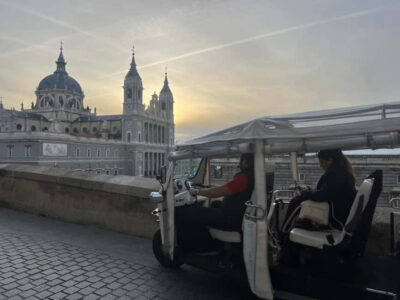

City Tours – 6 seats private ecological tuk tuk
Read our review →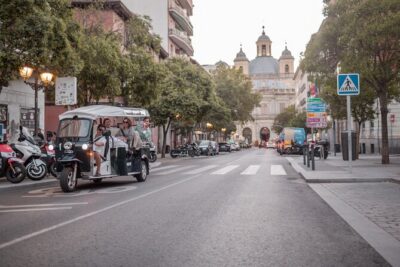
Madrid Expert Tour with Local Guide in Eco Tuk Tuk Private
Read our review →Browse the lists this tour appears in