

Review · GERMANY
Münster Unpacked Tour : Rickshaw City Tour with Guide
Münster’s story comes together quickly from the back seat of a rickshaw. In about an hour, you pass the Peace Hall, cathedral, castle, Lambert’s Church, a famous bookshop, a baroque palace, and leafy Aasee. It is a useful first look at a city where bikes, history, student life, and public art share the same streets.
I like the small-scale ride, which gets you around more easily than a walking tour while keeping you close to the streets. I also like the range of stops, from the Anabaptist cages at Lambert’s Church to practical market advice and modern sculpture at Aasee. The main drawback is time: one hour is tight, and a rickshaw with a weak battery can make the ride slower and shorten the sightseeing.
Key points to know before booking
- Peace Hall context: Learn why Münster mattered to the Peace of Westphalia, the Hanseatic League, and the 2023 G7 meeting.
- Seven varied stops: The route covers major sights, local stories, a television-famous bookshop, and Aasee’s park.
- Guides with personality: Stefan and George are named guides, and the tour also uses friendly female guides.
- Good for an overview: You get a broad introduction without committing to a long walk.
- Market-day insight: On Wednesdays and Saturdays, the route includes stories and practical advice about Münster’s weekly market.
- Battery caveat: Ask about the rickshaw’s power and pace if mobility or timing matters to you.
A rickshaw introduction to Münster
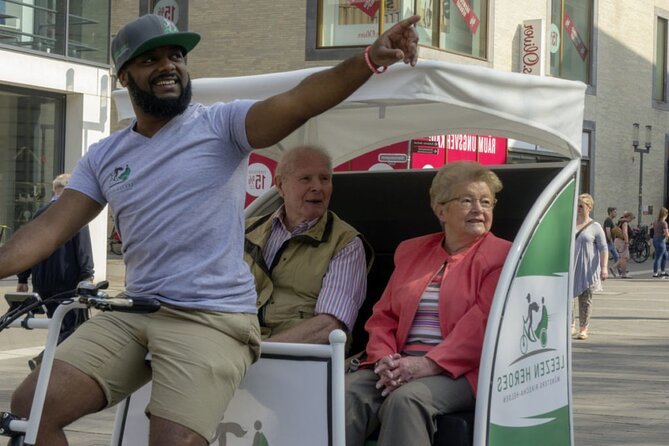
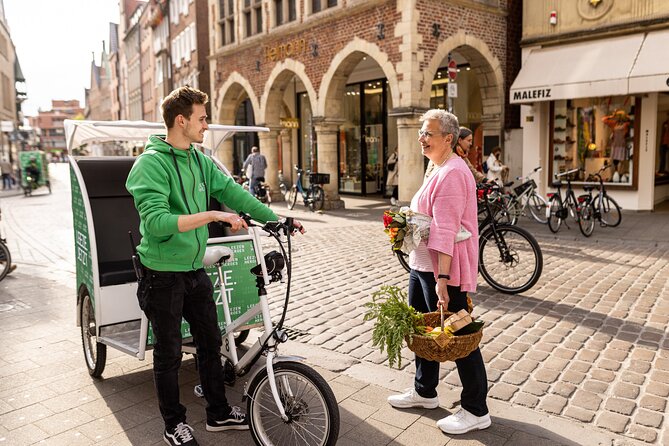
This is a private-transportation city tour with a maximum of 14 people, though a single rickshaw experience naturally feels much more personal than a large coach tour. The meeting point is Prinzipalmarkt 10, in the middle of Münster’s historic center, and the ride returns there after roughly one hour.
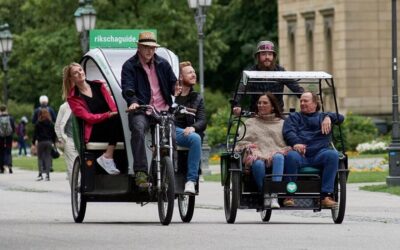
The rickshaw is a smart match for Münster. The city is famous for cycling, and a small vehicle fits the character of the place better than a sightseeing bus. You are close enough to hear the guide and look up at buildings without craning your neck through a window.
The format also saves energy. If you want an introduction before exploring on foot, this gives you a quick map of the center and points out places you might otherwise pass without understanding. It is especially useful if you want to see several districts or landmarks but do not want a full walking tour.
The tradeoff is that this is an overview, not a long historical visit. Most stops receive about five minutes, with ten minutes at Aasee. You will hear the main story and see the setting, but you should not expect extended time inside each building.
More Rickshaw Tours in Germany
- Münster-Highlights-Tour with Rickshaw-Guide
★ 4.8 · 244 reviews - Cologne: Rickshaw Sightseeing Tour
★ 4.8 · 180 reviews - Berlin: Private Guided E-Rickshaw Tour
★ 4.9 · 157 reviews
Prinzipalmarkt, the Peace Hall, and Münster’s political past

The tour starts near Prinzipalmarkt, one of Münster’s key historic settings. From here, the first stop is the Historisches Rathaus, or historic town hall, home to the Friedenssaal, the Peace Hall.
The Peace Hall gives the tour an unusually strong opening. Münster was one of the places involved in the peace negotiations that ended the Thirty Years’ War in 1648. The stop also connects the city to the Hanseatic League, the medieval trading network that shaped commerce across northern Europe.
The guide also points out the building’s current political role. Münster hosted a G7 meeting in 2023, so this is not only a medieval or early modern site. It remains a place where public affairs and international politics take place.
You receive about five minutes here, with free admission included. That means the value comes mainly from the explanation and the exterior setting rather than from a long interior visit. If the Peace Hall is your main reason for coming, you may want extra time in Münster after the rickshaw ride.
Münster Cathedral and the city’s starting point
The next stop is St. Paulus Dom, Münster Cathedral. This is presented as the place where Münster was founded, giving you a direct link between the city’s origins and its present center.
A five-minute stop cannot cover every chapter of the cathedral’s story. Still, the location is useful because it helps you understand why the cathedral quarter became the city’s historic heart. The guide uses the site to tell stories rather than simply point at a large church.
I would treat this as an orientation stop. Look closely at the building, listen for the founding stories, and note where you are in relation to the market and other central sights. If you want a quiet look inside, plan to return independently, since the scheduled stop is brief and admission is listed as free.
The weekly market on Wednesdays and Saturdays
The market portion adds a practical local touch to the tour. On Wednesdays and Saturdays, Münster’s weekly market brings extra activity to the city center, and the guide explains how the markets developed.
This part is useful because it goes beyond monuments. You get advice about how the market works and tips for making the most of it. For someone spending more than a day in Münster, that information can help shape the rest of the visit.
The market is tied to particular days, so you should not assume the full market spectacle will be present on every departure. The tour description specifically identifies Wednesday and Saturday as market days. On another day, you can still hear the market story and receive practical advice, but the atmosphere may be different.
Same streets, a different route:
- Erfurt: Private Guided Classic Old Town E-Rickshaw Tour
★ 4.9 · 153 reviews - Munich: City Highlights Rickshaw Tour
★ 4.9 · 150 reviews - Individual City Tour – Rickshaw Sightseeing in Berlin
★ 5.0 · 120 reviews - Berlin Express: Private 1-Hour E-Rickshaw Ride
★ 5.0 · 116 reviews
Schloss Münster and the castle garden
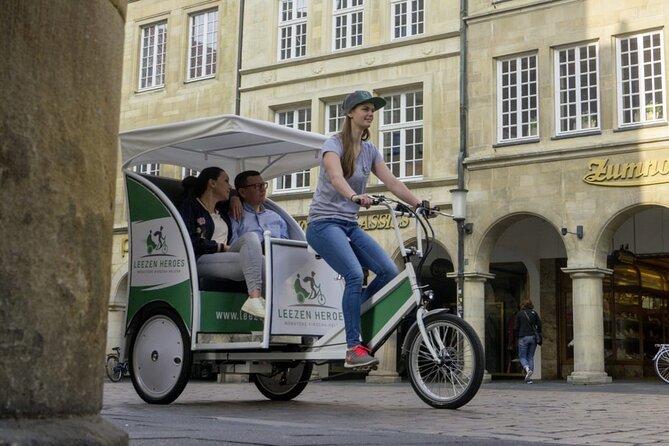
Schloss Münster was built in 1780 as the palace of the prince-bishop. Its formal design gives the tour a change of mood after the medieval center and cathedral.
The guide can also include a look at the castle garden if you are interested. That option is worth considering if you enjoy open space, formal planting, or a pause from dense city streets. The planned stop is about five minutes, so think of it as a short introduction rather than a garden visit in its own right.
This stop also helps explain Münster as more than a collection of old churches. The city’s past includes religious rule, court life, civic power, and grand architectural projects. The palace gives that story a clear visual setting.
St Lambert’s Church and Münster’s stranger stories
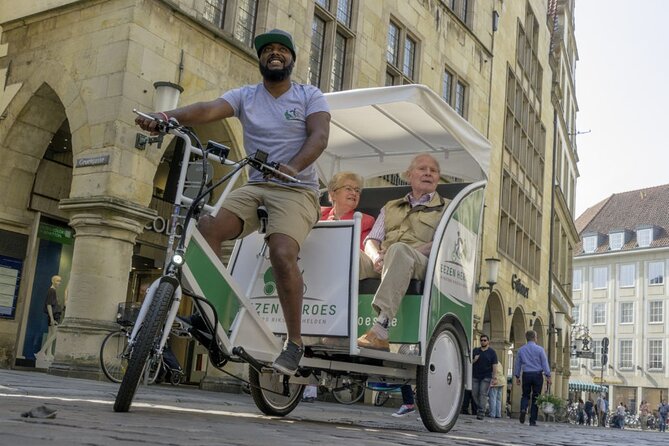
St Lambert’s Church is likely the most story-filled stop on the route. The guide covers the tower woman, the baskets of the Anabaptists, classical poets, and modern art.
The Anabaptist baskets are the detail that gives this stop its edge. In the 1530s, radical Anabaptist leaders took control of Münster and attempted to establish a religious kingdom. After the revolt was defeated, their bodies were placed in iron cages on the church tower. The cages remain a stark reminder of how much conflict lies behind the city’s calm streets.
The tower woman adds a different layer. The church has a long connection with a woman who keeps watch from the tower, a role tied to Münster’s civic traditions. The guide also links the church to literature and modern art, showing how one landmark can carry several eras at once.
Again, you have about five minutes. That is enough for a strong introduction, but not enough to inspect every detail or linger over the church. If this story interests you most, make a note to return on foot.
Antiquariat Michael Solder and the Wilsberg connection
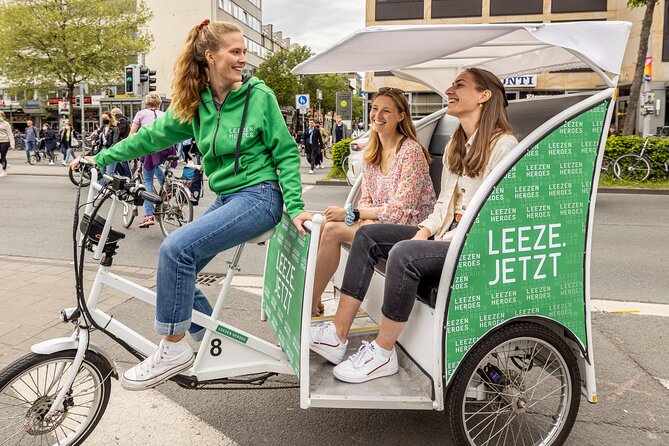
Antiquariat Michael Solder is an antiquarian bookshop known from the ZDF television series Wilsberg. This gives the tour a lighter, more contemporary stop after the heavier history of Lambert’s Church.
For fans of the series, the connection adds a personal reason to pause. For everyone else, the bookshop still offers a glimpse of Münster’s literary and television identity. It is a reminder that the city is not only a museum of old buildings. It also appears in modern German popular culture.
The stop lasts about five minutes and does not list an admission charge. Consider it a quick photo and orientation point rather than a scheduled shopping visit. If you like old books, you may want to return later with more time to browse.
Erbdrostenhof and the details you might miss

Erbdrostenhof is a baroque palace built for a high-ranking official of the prince-bishop. Its grand façade catches your eye at once, but the guide’s point is that the building rewards a second look.
That is a good reason to see it with someone who can direct your attention. From the rickshaw, you can take in the overall shape first, then look for the smaller details that are easy to miss when walking past alone.
This is another short stop, about five minutes. The tour does not promise an interior visit, so judge it as an architectural pause. It works well as part of the wider route, especially because it connects to Schloss Münster and the city’s baroque chapter without using up a large block of time.
Aasee, sculpture, and a change of pace
The final major stop is Aasee, Münster’s scenic lake park. At ten minutes, it receives twice the time of most other stops, which makes sense. The area is less about one building and more about the feel of the city.
The guide discusses sculptures around the park and offers suggestions for going out. This is useful if you want to see how Münster mixes art with everyday public space. You can also use the stop to decide if Aasee deserves a longer return visit.
Aasee broadens the tour’s picture of Münster. The historic center tells you about bishops, merchants, religious conflict, and diplomacy. The lake shows a more relaxed side, with open space, public art, and places connected to leisure.
The route then returns to the meeting point. Because Aasee receives the longest scheduled stop, this is a good place to ask the guide for restaurant or evening suggestions. One guide specifically recommended a restaurant during the ride, so a direct question can be worthwhile.
What the guides add to the experience
The strongest part of this tour is the guide’s delivery. The named guides Stefan and George are associated with clear, friendly explanations, and the tour also uses personable female guides. The best descriptions of the experience point to vivid, varied, humorous, and empathetic storytelling.
That matters on a one-hour route. With only a few minutes at each sight, a guide needs to select details well. A dry list of dates would make the ride feel rushed. A good guide gives you a thread to follow, moving from Münster’s founding to its religious conflicts, baroque power, modern art, and everyday life.
The experience is not guaranteed to feel the same with every guide. One dissatisfied customer found the history boring and felt it could have been read online. That criticism is fair to consider. The value depends heavily on whether your guide makes the stories lively and answers the questions you care about.
Price, pace, and the battery question
The listed price is $41.57 per person. For a private-style introduction with transportation and a guide, that can be reasonable if you value comfort and a fast overview. It is less convincing if you mainly want long interior visits or detailed historical teaching.
A rickshaw also helps you cover more ground without the physical demand of walking between every stop. Several of the city’s sights are presented in one compact route, and most travelers can participate. Service animals are allowed, and the meeting point is near public transportation.
There is one practical warning. A past ride had a rickshaw with a drained battery, leaving the driver to pedal slowly in first gear. The hour then felt shorter than expected. This appears to be an isolated problem rather than the normal arrangement, but it is worth asking about the vehicle’s condition if the pace matters to you.
The maximum group size is 14, but ask how many people are booked for your departure if you want the most personal setting possible. Smaller numbers should make it easier to hear the guide and ask questions, while a fuller vehicle may feel less flexible.
Who should book the Münster rickshaw tour?
I would recommend this ride to first-time visitors who want a quick orientation, people who prefer seated sightseeing, and anyone with limited time in Münster. It also suits families or mixed-age groups who may not want a long walking route.
It is a good fit for visitors who enjoy varied stories rather than one narrow subject. The route moves from the Peace Hall and cathedral to the Anabaptist cages, a television-linked bookshop, baroque architecture, and public art at Aasee.
I would be more cautious if you want a detailed cathedral visit, extensive time at the Peace Hall, or a slow architectural study. In that case, use the rickshaw as your introduction and return to the most interesting places afterward.
Book at least 24 hours ahead if you want the option of a full refund after changing plans. Cancellations made less than 24 hours before the start time are not refunded, and late changes are not accepted. The tour is offered in English, with confirmation provided at booking.
Should you book it?
Book it if you want a comfortable, compact first look at Münster and value a guide who can connect famous sights with unusual local stories. The route is varied, the rickshaw suits the city, and the ride can help you decide where to spend more time later.
Skip it if your main goal is extended time inside monuments or a detailed academic history lesson. Also ask about the rickshaw’s battery and the likely group size before paying. At $41.57, the tour offers fair value when the guide is engaging and the vehicle runs well, but the short schedule leaves little room for delays.
FAQ
Where does the Münster rickshaw tour start?
The tour starts at Prinzipalmarkt 10, 48143 Münster, Germany.
Where does the tour end?
The activity ends back at the meeting point on Prinzipalmarkt.
How long does the tour last?
The tour lasts approximately one hour.
What language is the tour offered in?
The tour is offered in English.
What is the price?
The listed price is $41.57 per person.
How many people can join?
The activity has a maximum of 14 participants.
Is transportation included?
Yes. Private transportation by rickshaw is included.
Does the tour visit the Münster Cathedral?
Yes. The route stops at Muenster Cathedral, also known as St. Paulus Dom, where Münster was founded.
Does the tour include the weekly market?
The guide discusses Münster’s weekly market and gives practical tips. The market is especially active on Wednesdays and Saturdays.
Is cancellation free?
You can cancel for a full refund up to 24 hours before the experience start time. Cancellations or changes made less than 24 hours before departure are not accepted for a refund.
Just added around Germany
- Winter Champagne Tour by Rickshaw★ 4.3 · 10 reviews
- Private and full rickshaw tour in the English Garden★ 4.5 · 10 reviews
- Private Munich Rickshaw City Tour and English Garden★ 5.0 · 49 reviews
- Private Hamburg rickshaw tour for 2 people★ 5.0 · 3 reviews
- One Up to 3 Rickshaws(6 GUESTS)-Taylor Made Rickshaw Berlin Tour★ 5.0 · 20 reviews
- Romantic Berlin Rickshaw City and Photo Tour – incl. pick-up★ 4.0 · 9 reviews
- Rickshaw Sightseeing Tours Berlin – Highlights Berlin – Rickshaw city tour★ 3.5 · 3 reviews
- Rickshaw Tour-Cruise Ship guests arrive 9.30 upto 11.30 am Berlin★ 5.0 · 7 reviews
Germany Tuk Tuk Tours, compared.


Individual City Tour – Rickshaw Sightseeing in Berlin
Read our review →
Crime show city tour by rickshaw including guide
Read our review →Browse the lists this tour appears in