
Review · ITALY
Olbia : Tuk-Tuk Tour – Ancient Treasures of Sardinia + pickup
Olbia’s best ancient sights sit well beyond its compact center, and this private tuk-tuk tour links them without making you rent a car. In about two and a half hours, you move from an early Christian basilica to Nuragic monuments, a Roman water system, and a medieval hilltop castle.
I like the small private format, since your group controls the pace better than it would on a large coach. I also like the variety: this is not just a quick circuit of Roman remains, but a brisk lesson in Sardinia’s long sequence of cultures.
The main consideration is the price, $180.21 per person. It makes more sense for a couple, family, or small group that values private transport and limited time than for someone happy to use a rental car or public transport. The guide service also relies partly on a recorded audio system, so it may feel less personal than a walking tour with continuous live explanation.
Key points before you book
- Ancient sites in one short outing: See Christian, Nuragic, Roman, and medieval remains in roughly 150 minutes.
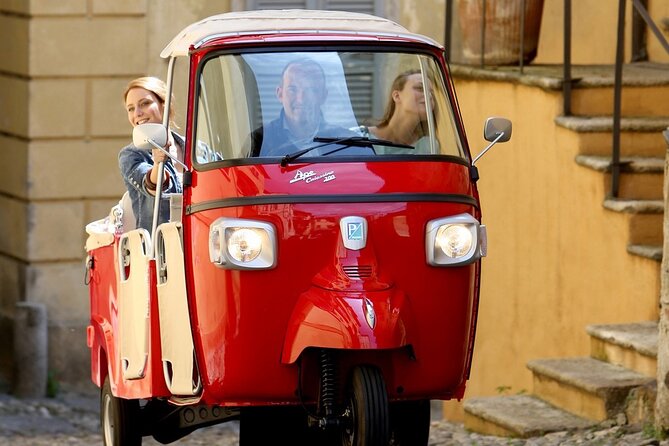
- Private tuk-tuk transport: Only your group participates, with a professional driver and onboard speakers for audio guidance.
- Best for car-free visitors: The outlying sacred well, aqueduct, giant’s tomb, and castle are much easier to reach this way.
- Free city-center pickup: Cruise passengers meet at the Maritime Station, while hotel or apartment pickup costs extra.
- Bring water and a light cover-up: Bottled water is not included, and a cardigan is required for church entry.
- Set realistic expectations: The route is a fast overview, with short stops and some recorded commentary rather than a full archaeological lecture.
Why Olbia works well by tuk-tuk
Olbia is easy to walk around in its central streets, but its most unusual historic sites are scattered across the wider area. A car is useful, yet renting one for a short port stop brings its own work: finding the sites, navigating unfamiliar roads, and watching the clock before your ship sails.
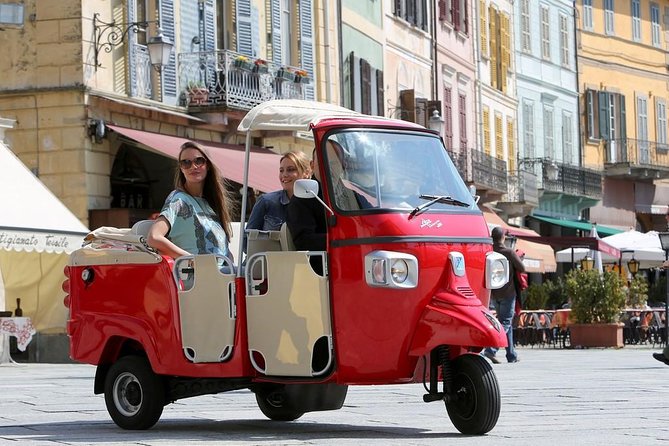
The tuk-tuk solves much of that problem. You sit in an open-sided vehicle, get driven between stops, and avoid the effort of arranging several separate taxi rides. Since the tour is private, your group does not have to share the vehicle with strangers or wait for a large bus to load.
The route is also pleasingly broad. You see how Olbia’s story stretches from Nuragic water worship and prehistoric burial monuments to Roman engineering, medieval fortification, and Christian worship. You will not study any one site at great length, but you get a useful framework for understanding the area.
The tradeoff is depth. The scheduled stops total about 75 minutes, leaving the rest of the two-and-a-half-hour outing for driving and brief looks at central Olbia. The clear audio system helps, but this is best treated as a well-organized introduction rather than a specialist archaeological tour.
A few more rides around Italy worth a look
- Florence Private Transportation in Rickshaw
★ 5.0 · 730 reviews - Florence: Private Transport by Rickshaw
★ 5.0 · 659 reviews - Sorrento Farm by Tuk Tuk: Cheese, Limoncello & Hands-On Pizza
★ 5.0 · 628 reviews
San Simplicio and the Christian heart of Olbia
The Basilica of San Simplicio is the first major historic stop. It is Olbia’s oldest and most important religious monument in northeastern Sardinia, and it is dedicated to Saint Simplicio, described as the city’s first bishop and a martyr under Emperor Diocletian.
The building served as Olbia’s cathedral until 1839 and became a parish church in 1955. Pope John Paul II gave it the title of minor basilica in 1993. Those dates help place the church within the long religious life of the city, rather than treating it as just another attractive old building.
You have about 10 minutes here, so expect a quick visit. The nearby necropolis beneath the basilica adds another layer. The site links Christian worship with earlier burial evidence, making it one of the more meaningful stops for anyone interested in how cities grow over older settlements.
Admission is not included at this stop. You should also carry a cardigan or other suitable cover-up, since church entry requires one. In July, the midday heat can be strong, and the short visit is welcome, but you will want to keep your expectations in check if you hoped to linger inside.
The route also passes through Olbia’s main historic street and reaches the Archaeological Museum. The supplied schedule does not assign separate visit times or admission details to either, so treat them as orientation points or brief drive-by sights rather than guaranteed extended museum visits.
Sa Testa, a Nuragic well built for ritual
The Sacred Well of Sa Testa is one of the tour’s most distinctive stops. It belongs to the Nuragic civilization of Gallura, a culture that shaped much of Sardinia before the Roman period.
The well was used for rituals connected with water. That purpose gives the monument a strong sense of place: this was not simply a practical water source, but a site where water had religious meaning. You have about 15 minutes and admission is included.
This is the sort of stop that benefits from a guide or audio explanation, because the stonework alone may not tell you how the monument functioned. The recorded system can provide context while you look around, though you should not expect a long, back-and-forth discussion at the site.
The visit is short enough that you will probably see the main structure without feeling rushed. It is also one of the places that would be awkward to reach without your own vehicle, which strengthens the case for this tour if you are staying in central Olbia or stepping off a cruise ship for the day.
The Roman aqueduct and its stone cistern
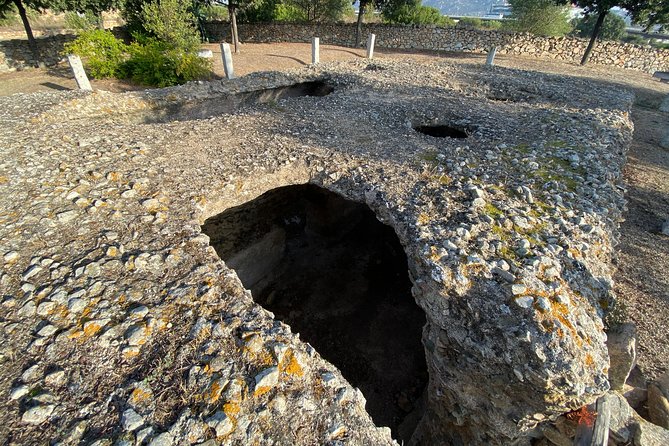
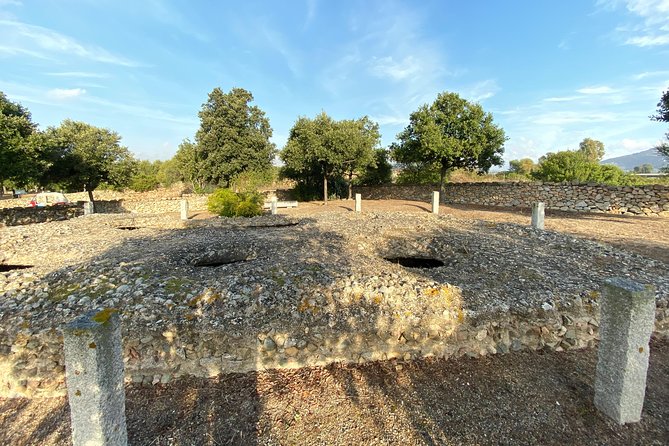
Olbia’s Roman aqueduct was built between the first and second centuries AD to carry water from springs on Mount Cabu Abas. The aqueduct is especially interesting because you can still see more than scattered stones.
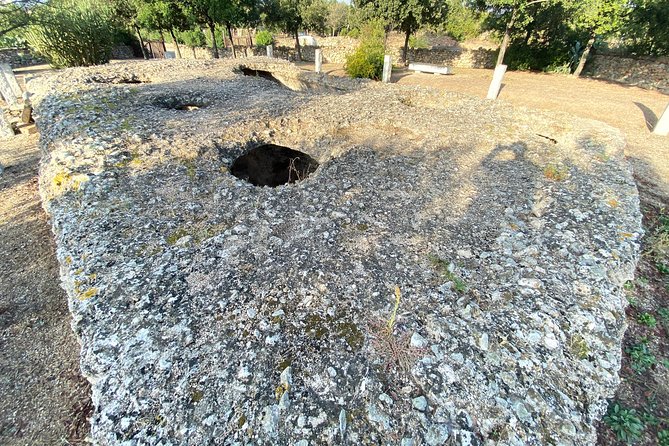
Beside it is a large settling tank cut directly into the rock. It has six ventilation openings, two smaller tanks, and wells for bringing water in and sending it out. Water channels remain visible on the arches, giving you a clear look at the engineering rather than only a few broken foundations.
You get about 15 minutes here, with admission included. The site is described as the best-preserved Roman archaeological site in Sardinia, so this is likely to be a high point for visitors who prefer practical Roman infrastructure to monumental ruins.
Again, time is limited. You will have enough time to understand the layout and take photographs, but not to examine every feature at leisure. Listen to the audio before wandering off, since the details about settling, ventilation, and water flow are what make the remains memorable.
Same streets, a different route:
- Bari: Old Town Guided Eco-Friendly Rickshaw Tour
★ 4.9 · 355 reviews - Private Tour of the Medieval Village of Ostuni by Tuk Tuk
★ 4.5 · 278 reviews - Lecce: City Highlights Guided Tour by Rickshaw
★ 4.8 · 236 reviews - Bari Rickshaw Tour
★ 5.0 · 233 reviews
The giant’s tomb at Monte ’e S’Abe
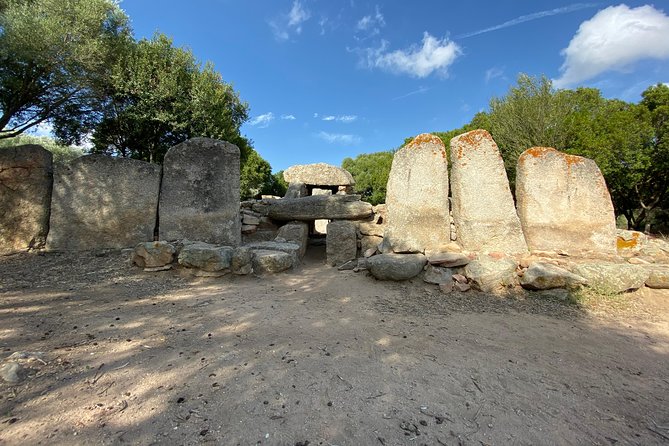
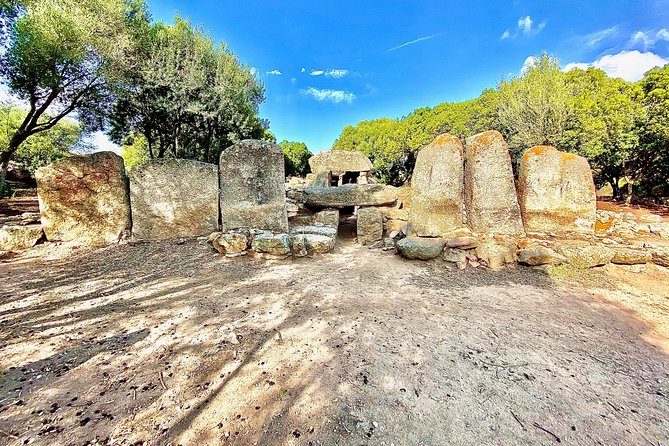
The Tomba dei Giganti Su Monte ’e S’Abe is a prehistoric monument more than 4,000 years old. Its form is associated with the head of a bull, an important Nuragic religious symbol.
The name giant’s tomb can sound dramatic, but it does not mean the site was built for actual giants. It refers to the imposing scale and appearance of these communal burial monuments. The bull imagery gives you a useful clue to the beliefs of the people who built it.
The stop lasts about 10 minutes and admission is included. That is enough for a close look and a short explanation, but not enough for a slow walk around the wider setting. If prehistoric archaeology is your main reason for booking, you may wish the schedule allowed more time here and at Sa Testa.
Still, the pairing works well. The sacred well shows ritual use of water, while the tomb shows burial practice and religious symbolism. Together, they make the Nuragic period more understandable than either stop would on its own.
Pedres Castle above the Olbian basin
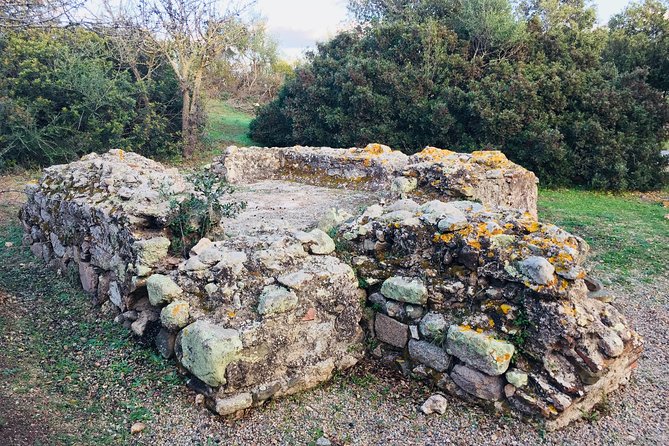
Castello di Pedres gives the tour a change of scale and scenery. The castle sits on an 89-meter fortress hill, overlooking the southern part of the Olbian basin.
Its origins date from 1296 to 1322, during the period of Pisan and Aragonese rule and the rise of the Visconti family. By this point in the route, you have moved far beyond prehistoric Sardinia and Roman administration into the medieval struggle to control the region.
The 25-minute stop is the longest scheduled visit, which makes sense. You need time to take in the hilltop position, walk around the remains, and look across the basin. The castle is not just a pile of old masonry. Its location explains its purpose, since height provided control and a broad view of movement through the area.
Wear practical shoes if you want to explore comfortably, though the supplied details do not specify the exact walking conditions. The tuk-tuk can bring you close to the site, but the visit itself is still on foot.
Olbia’s city center and Fausto Noce Park
The tour is not limited to ruins. It also takes in the main street of the historic center and Fausto Noce Park, known as Olbia’s green lung.
The park covers 18 hectares and was named Italy’s second-best green project in 2005. That gives you a sense of the city beyond its ancient monuments. After several archaeological stops, the park offers a modern, open contrast.
There is no separate timing listed for the park or the historic street. You may see them during the driving portion rather than stopping for a full visit. If your priority is shopping, cafés, or a relaxed walk through central Olbia, plan extra time before or after the tour.
The Archaeological Museum is another useful point of orientation. Since no separate entrance or visit duration is specified, do not assume the tuk-tuk outing includes a full museum visit. Ask the operator if you want to build museum time into a custom route, keeping in mind that personalized routes outside the standard plan cost extra.
What the commentary is really like
The tour is offered in English and includes a clear speaker system for audio guidance. That is helpful in a tuk-tuk, where engine noise and passing traffic can make quiet speech difficult.
You should understand the difference between an English-speaking driver and a dedicated live guide. The service includes a professional driver, and the audio system supplies historical information. Some departures may offer more direct explanation, but the published details do not promise continuous live commentary from a specialist guide.
That arrangement will suit you if you want organized transport and concise background at each stop. It may disappoint you if you expect a guide to lead every walk, answer detailed questions, and explain every monument in real time.
A practical tip: pay attention to when the audio begins. Recorded information can arrive a little before or after the feature you are looking at, so it helps to stay with the group and listen before moving on.
Is $180.21 per person fair?
At $180.21 per person, this is not a cheap sightseeing ride. The value comes from combining a private vehicle, a professional driver, several admissions, and transport to sites that are not conveniently connected by a simple central walking route.
The price is easier to justify for a small group arriving by cruise ship. You can cover a lot in two and a half hours without arranging your own car, and city-center pickup is free. A hotel or apartment transfer costs extra, so confirm the final amount before booking.
For a solo visitor, the cost is harder to defend unless convenience matters more than budget. For two or more people sharing a private experience, the time saved may make the price reasonable, especially if the alternative is several taxis.
Water is not included. Bring your own bottle, particularly in hot weather. The lack of included water was a real point of irritation for one departing group, but the tour information clearly excludes it, so pack accordingly.
Cruise-port pickup and timing tips
Cruise passengers should take the free shuttle from the ship to Olbia’s Maritime Station. After leaving the shuttle, exit through the station’s main entrance, where a representative holding a Smeralda 360 sign should meet you.
Arrive at least 10 minutes early. The vehicle is recognizable by the Smeralda 360 writing on its sides. If you are staying in a hotel or apartment, pickup is from the main entrance, and you should wait outside at the scheduled time because the driver can wait only a few minutes.
The tour ends at the meeting point. Hotel pickup is an optional paid service, while city-center pickup is free. Since cruise schedules can change, check the cancellation terms carefully: you can receive a full refund if you cancel at least 24 hours before the start time, but late cancellations and changes are not accepted.
The experience also depends on good weather and a minimum number of participants. If the operator cancels for either reason, you are offered another date or experience, or a full refund.
Who should book this Olbia tuk-tuk tour?
I would recommend it to you if you have a short stay, do not want to rent a car, and want more than a city-center stroll. It is particularly useful for cruise passengers who need a tidy route with return transport and clear timing.
It also suits families and small private groups that prefer their own vehicle. The open tuk-tuk format makes the journey part of the experience, and the stops provide enough variety to keep the outing from becoming a single-style ruins tour.
I would hesitate if you want a slow archaeological study, a museum-heavy day, or detailed live discussion at every stop. The route is brisk, some commentary is recorded, and the price is high for anyone who only wants to see one or two monuments.
Plan for warm conditions, bring water, carry a cardigan for San Simplicio, and wear shoes suitable for the castle stop. With those basics covered, you can focus on the remarkable range of Sardinian history packed into a short ride.
Should you book it?
Book this tour if convenience is your priority and you want to connect Olbia’s main ancient sights without driving. The sacred well, Roman aqueduct, giant’s tomb, and Pedres Castle are the strongest reasons to go, while the private tuk-tuk keeps the route efficient.
Skip it if $180.21 feels too steep or if you want a deeply personal guide-led archaeology experience. In that case, a rental car or a shorter city tour may give you better value. For a port call with limited time, though, this is a practical way to see far more than Olbia’s central streets.
FAQ
How long does the Olbia tuk-tuk tour last?
The experience lasts approximately 2 hours and 30 minutes.
What sites are included?
The route includes the Basilica of San Simplicio, the Sacred Well of Sa Testa, the Roman aqueduct, the Tomba dei Giganti Su Monte ’e S’Abe, and Castello di Pedres. It also takes in Olbia’s historic center, the Archaeological Museum area, the necropolis beneath San Simplicio, and Fausto Noce Park.
Is the tour private?
Yes. Only your group participates in the activity.
Is pickup included?
Free pickup and drop-off are available from the city center. Cruise passengers meet at Olbia’s Maritime Station. Hotel or apartment pickup is available for an additional charge.
Is the tour offered in English?
Yes. The experience is offered in English and includes an audio system with speakers for historical guidance.
Are entrance fees included?
Admission is included at the Sacred Well of Sa Testa, the Roman aqueduct, the Tomba dei Giganti, and Castello di Pedres. Admission to the Basilica of San Simplicio is not included.
Is bottled water provided?
No. Bottled water is not included, so you should bring your own.
What is the cancellation policy?
You can cancel at least 24 hours before the start time for a full refund. Cancellations or changes made less than 24 hours before the start time are not accepted. If bad weather or insufficient participation causes the operator to cancel, you are offered another date or experience, or a full refund.
Just added around Italy
- Tuk Tuk Coastal Tour★ 5.0 · 10 reviews
- Private Tuk Tuk Tour of the Millenary Olive Groves in Ostuni★ 5.0 · 4 reviews
- Syracuse and Ortygia and Park Neapolis Tuk-Tuk Tour★ 5.0 · 5 reviews
- Siena E-Tuk Tuk panoramic Aperitivo with Local Snacks★ 5.0 · 2 reviews
- 2 Hours Calessino/ Tuk tuk Tour to Syracuse and Ortigia Island★ 4.5 · 34 reviews
- Ortigia APE-TUK TUK 1-hour private tour★ 5.0 · 22 reviews
- From San Gimignano: Tuscany Wine tour by Tuk Tuk with Lunch★ 5.0 · 13 reviews
- Tour of Vietri and its villages on board the Ape Calessino (tuktuk)★ 5.0 · 9 reviews
Italy Tuk Tuk Tours, compared.

Sorrento Farm by Tuk Tuk: Cheese, Limoncello & Hands-On Pizza
Read our review →
Private Tour of the Medieval Village of Ostuni by Tuk Tuk
Read our review →

Browse the lists this tour appears in