
Review · LISBON
Lisbon: Private Professional Guided Tuk-tuk Tour
Lisbon makes the most sense from a tuk-tuk seat. You can slip through Alfama’s narrow lanes, climb to hilltop viewpoints, then roll along the Tagus to Belém without spending the day fighting steep streets and long walks. This four-hour private tour links the city’s major sights with a guide who can explain what you are seeing as you go.
I like the private format, since your group gets the guide’s attention and can ask questions without a large crowd around you. I also like the range: old squares, tiled Alfama, riverfront Lisbon, and the grand monuments of Belém all fit into one outing. The main drawback is street noise. Joana was praised for her clear explanations in English and Spanish, but a microphone or headphones would make the commentary easier to hear while the tuk-tuk is moving.
Key points at a glance
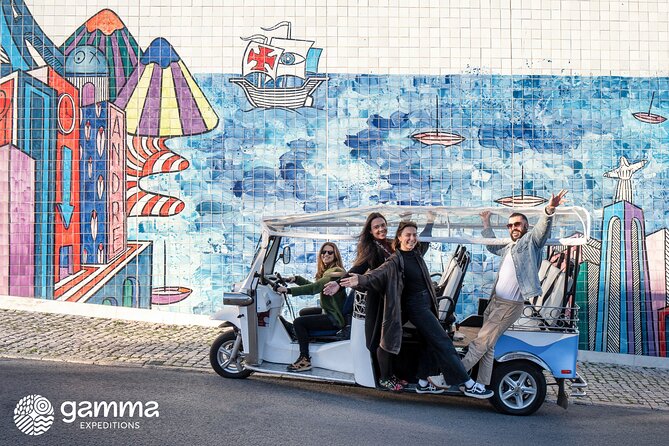
- A full Lisbon sweep in four hours: Cover the historic center, Alfama, several viewpoints, the riverfront, Chiado, Bairro Alto, and Belém.
- Private transportation: Only your group participates, with pickup at Avenida da Liberdade 2 and return to the same meeting point.
- Joana earns special praise: Her warm manner, useful history, and practical advice for day trips beyond Lisbon made a strong impression.
- Tickets are extra: The cathedral, National Pantheon, Jerónimos Monastery, Belém Tower, and Monument to the Discoveries are viewed with admission costs not included.
- The hills are handled for you: A tuk-tuk is especially useful in Lisbon’s steep districts and tight lanes.
- Best for first-time visitors: You get a broad orientation before deciding where to return on foot.
Why a tuk-tuk works well in Lisbon

Lisbon is compact on a map but demanding on foot. The city rises and falls sharply, its old lanes can be confusing, and some of its finest viewpoints sit above the main streets. A tuk-tuk gives you a practical way to cover ground while keeping the day lighter on your legs.
This is not a slow, single-neighborhood outing. The route moves from central Lisbon to Alfama, across the main riverfront, through Chiado and Bairro Alto, and out to Belém. That makes it useful on a first or second day, when you want to learn the city’s shape before choosing which places deserve more time.
The private setup matters. You are not being fitted into the pace of a large group, and you can ask your guide to explain a monument, clarify a neighborhood, or suggest what to do later. The tour is also offered with pickup, though the stated meeting point is Av. da Liberdade 2, 1250-144 Lisboa. It finishes back there.
At $144.18 per person, this is not the cheapest way to see Lisbon. The value comes from the private vehicle, a professional guide, and the amount covered in four hours. If you are traveling alone or as a couple, the price may feel high. For a family or small group splitting the cost, it becomes easier to justify, especially since a private ride saves you from organizing several separate visits.
A few more rides around Lisbon worth a look
- True 4Hour Private Tuk Tuk Tour: Discover Lisbon with a Local!
★ 5.0 · 8,008 reviews - Lisbon: Private Guided Tuk-Tuk Tour with Hotel Pickup
★ 4.9 · 4,552 reviews - Private Lisbon Sightseeing Tuk-Tuk Tour: Alfama, Belém & More
★ 5.0 · 4,277 reviews
Restauradores, Rossio, and the planned Baixa
The tour begins around Restauradores Square, marked by its 30-meter obelisk. The monument recalls Portugal’s break from Spanish rule in 1640, giving you an early lesson in the country’s political story before the route moves into the city center.
Rossio Square, officially Dom Pedro IV Square, is one of Lisbon’s best places to get your bearings. Its black-and-white wave-patterned paving is a classic Lisbon detail, and the statue of Dom Pedro IV gives the open space a clear focal point. Café Nicola adds old café atmosphere, while the nearby metro station explains why this square feels like a meeting point as well as a monument.
From here, you pass through Baixa Pombalina, the orderly downtown rebuilt after the earthquake of 1755. The straight streets and uniform façades are not an accident. They reflect a planned response to disaster, with broad routes and neoclassical buildings replacing much of the older medieval city.
I like this early section because it gives Lisbon a useful contrast. Rossio and Baixa feel open, organized, and easy to read. Soon, the tuk-tuk turns toward districts where the streets become steep, crooked, and much older.
Lisbon Cathedral and the first Alfama viewpoints

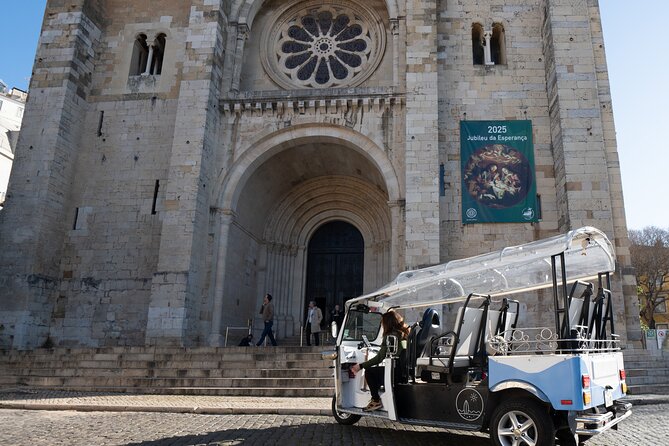
The Lisbon Cathedral, or Sé de Lisboa, dates from the 12th century and combines Romanesque, Gothic, and Baroque elements. Its strong façade and twin towers have a fortress-like quality, fitting the older part of the city. Inside are chapels, a quiet nave, and archaeological remains linked to Roman and Moorish periods.
You have about 15 minutes at the cathedral, and admission is not included. That is enough for a quick look, but not for a slow visit to every chapel and archaeological feature. If the cathedral matters to you, ask the guide how best to use the time, or plan to return independently.
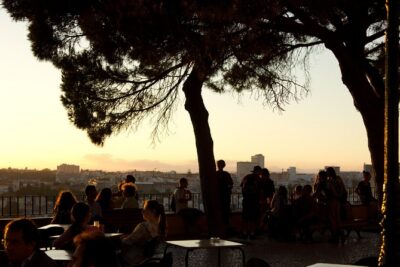
Next comes Portas do Sol, one of Lisbon’s most rewarding viewpoints. From here, the red roofs of Alfama fall toward the Tagus, and the district’s tight streets make more sense from above. You get 15 minutes, with no admission charge, which is enough for photographs and a quick look at the tiled surroundings.
The Senhora do Monte viewpoint offers another angle. In the Graça district, this lookout includes views toward São Jorge Castle, the Tagus, and the 25 de Abril Bridge. It has a small chapel and a calmer feel than some central viewpoints. Again, the stop lasts about 15 minutes and costs nothing to enter.
These two lookouts are similar in purpose but different in mood. Portas do Sol places you close to Alfama’s best-known postcard views. Senhora do Monte gives you a wider city panorama and a quieter pause above the streets.
Feira da Ladra, the Pantheon, and Alfama on foot
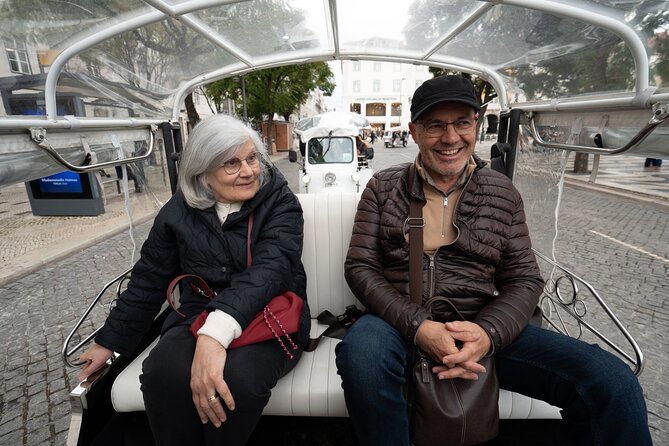
Feira da Ladra takes place on Tuesdays and Saturdays at Campo de Santa Clara. This open-air market sells antiques, second-hand goods, books, art, and assorted curiosities. The planned stop is only 10 minutes, so think of it as a quick taste rather than a proper market visit.
The schedule matters here. If your tour does not fall on Tuesday or Saturday, you will not find the market operating in its usual form. Even when it is open, you may need more time if you want to browse or buy something. The flea market is best treated as a bonus, not the main reason to book the tour.
The National Pantheon is housed in the former Church of Santa Engrácia, with a large dome and white Baroque exterior. It honors important Portuguese figures, including presidents, writers, and cultural names. The planned stop is five minutes, and admission costs extra, so the tuk-tuk may simply give you an exterior look unless you choose to enter.
Then comes Alfama itself. This is where the tour’s vehicle earns its keep. The neighborhood is filled with narrow lanes, steep stairways, colorful homes, tiled walls, taverns, and places associated with Fado. A tuk-tuk can show you the district’s shape without asking you to climb every slope.
The 15-minute Alfama stop is brief, but it gives you a chance to step out and absorb the setting. I would not expect this tour to replace a long Alfama walk. Instead, it helps you identify places you may want to explore later, such as the cathedral, viewpoints, or Fado streets.
Same streets, a different route:
- Lisbon Highlights: Private Tuk Tuk Tour Adventure Sightseeing
★ 5.0 · 3,284 reviews - Welcome Lisbon Tour with Local Guide in Private Eco Tuk Tuk
★ 5.0 · 1,691 reviews - Lisbon: Private City Tour by Eco Tuk Tuk
★ 4.9 · 1,215 reviews - Lisbon: Old Town TukTuk Tour and Scenic Viewpoints in Alfama
★ 5.0 · 974 reviews
The riverfront and Praça do Comércio
After the old quarters, the route opens out at Ribeira das Naus. This waterfront promenade runs between Cais do Sodré and Praça do Comércio along the Tagus. The area combines river views, open paving, benches, and reminders of Lisbon’s shipbuilding past.
It is a useful change of pace after the hills. You can look across the water, see the 25 de Abril Bridge, and understand how closely Lisbon’s identity is tied to the river. The tour does not list a fixed stop length here, so the time available depends on the route and traffic.
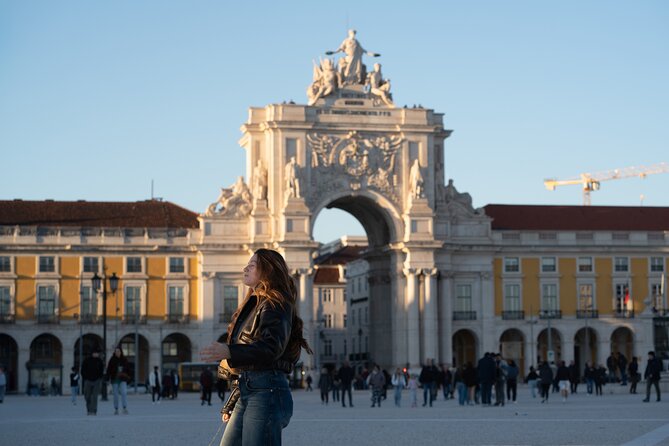
Praça do Comércio is one of Lisbon’s grandest public spaces. Once the site of the royal palace, it was rebuilt after the 1755 earthquake and now opens directly toward the Tagus. Yellow Pombaline buildings frame the square, while the statue of King José I sits in the center.
You get about 10 minutes here, with no admission charge. That is enough to walk around, take in the Arco da Rua Augusta, and photograph the riverfront. The square is broad and easy to appreciate quickly, unlike Alfama, which rewards slower wandering.
Chiado, Bairro Alto, and São Pedro de Alcântara

Chiado brings a more polished, literary side of Lisbon. The neighborhood is known for shops, theaters, historic buildings, and cafés such as A Brasileira. It sits between Baixa and Bairro Alto, making it a natural link between the lower city and the hill districts.
The route then reaches São Pedro de Alcântara, a landscaped viewpoint in Bairro Alto. From the terrace, you can look toward São Jorge Castle, central Lisbon, and the Tagus. A tiled map helps identify the landmarks, and the garden gives you a comfortable place to pause.
The stop lasts about 15 minutes and is free. Sunset would give the view extra warmth, but the tour’s timing is not fixed around sunset, so you should not book it expecting that particular light. Even in daylight, this is one of the clearest places to understand how Lisbon’s hills fit together.
Bairro Alto itself has two personalities. During the day, the streets are relatively quiet, with shops, galleries, and old façades. At night, bars, restaurants, and Fado venues change the mood. Seeing it during a daytime tour gives you orientation, but not its full evening character.
The 25 de Abril Bridge and the road to Belém
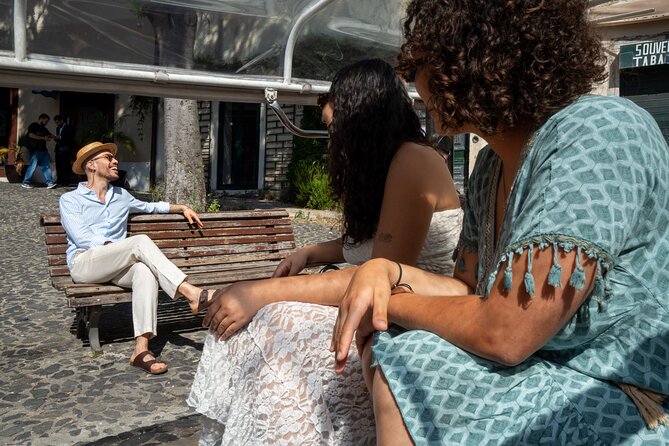
The red 25 de Abril Bridge is one of Lisbon’s most recognizable sights. It crosses the Tagus between the city and Almada, carrying road traffic above and trains below. Its color and suspension design often bring San Francisco to mind, but its place in Lisbon is tied to the city’s river, industry, and modern growth.
The bridge is especially striking from the waterfront and from higher viewpoints. On this tour, you see it as part of the city’s wider pattern rather than as an isolated photo stop. That context is useful: Lisbon’s old quarters are not the whole city. The bridge shows its modern side and its connection across the river.
Belém changes the scale again. The district is linked to Portugal’s Age of Discovery and to the voyages that shaped the country’s wealth, power, and identity. It is also where the tour spends its longest listed stops, with roughly 20 minutes at each main monument.
Jerónimos Monastery in 20 minutes
Jerónimos Monastery is the major architectural stop in Belém. Built in the 16th century after Vasco da Gama’s voyage to India, it is a showcase of Manueline design, with carved stonework, maritime references, and botanical details.
The monastery includes the tombs of Vasco da Gama and the poet Luís de Camões. Admission is not included, and 20 minutes is enough for a focused visit only if entry is straightforward. The cloisters and interior details deserve more time than the schedule allows, so you may prefer to return on your own if architecture is a priority.
Still, even a short stop helps you understand why Belém matters. The building is not just decorative. It links Lisbon’s religious monuments with the sea voyages that shaped Portuguese national memory.
Belém Tower and the Monument to the Discoveries
Belém Tower sits on the riverbank and once helped defend the entrance to Lisbon. Its Manueline carvings include maritime details, while the compact fortress form gives it a different character from the monastery.
You have about 20 minutes here, with admission extra. The exterior is easy to appreciate quickly, but entering the tower may take more time than the schedule comfortably allows. Ask your guide how the timing works on the day before buying tickets.
The Monument to the Discoveries is shaped like the prow of a ship and presents figures connected with Portuguese exploration, including Henry the Navigator and Vasco da Gama. A compass rose at the base shows distances to former Portuguese territories. The observation deck offers views over Belém and the Tagus, but admission is not included.
These three Belém sights work well together. Jerónimos represents faith and royal ambition, Belém Tower represents defense and the river entrance, and the Monument to the Discoveries presents the national story in bold modern form. The tour gives you a quick introduction to all three, then leaves you to decide which deserves a longer visit.
Guide quality, sound, and the private experience
The strongest personal detail available about the tour concerns Joana. She is praised for giving clear historical information in English and Spanish, helping with plans for day trips outside Lisbon, and following up with useful recommendations. That kind of local guidance can be worth as much as the sightseeing itself, especially early in a Portugal trip.
The tour is listed in English, and the standout feedback specifically praises Joana’s English and Spanish communication. If you need another language, confirm it before booking rather than assuming it is available.
The practical weakness is sound. Tuk-tuks are open to street noise, and the vehicle’s movement can make it hard to catch every sentence. A small microphone or headphones would help. You can also improve the experience by sitting where you can hear the guide clearly and asking for important details to be repeated at a stop.
The private format helps balance that issue. You can stop your guide when traffic gets loud, ask for a short explanation once parked, and focus the conversation on what interests your group.
Who should book this tour?
I would choose this tour for a first visit to Lisbon, especially if you want a broad picture in half a day. It suits families, small groups, and anyone who finds Lisbon’s hills and uneven streets tiring. Children from age three can participate, and service animals are allowed.
It is also a good choice if you have limited time and want to see both the historic center and Belém. You will not explore every monument in depth, but you will learn where the major districts sit and which places deserve a return visit.
I would be more cautious if your main goal is long interior visits. The cathedral, National Pantheon, Jerónimos Monastery, Belém Tower, and Monument to the Discoveries all have admission costs outside the tour price, and the listed stop times are short. This is a moving overview, not a four-hour museum program.
Confirmation is provided when you book, and free cancellation is available up to 24 hours before the start time. Last-minute changes or cancellations inside that window are not accepted for a refund.
Should you book the Lisbon tuk-tuk tour?
Book it if you want private transport, strong city coverage, and useful orientation in four hours. The combination of Alfama’s hills, central squares, viewpoints, and Belém’s major monuments is hard to match on foot in the same time.
The $144.18 per-person cost makes the most sense when several people share the private vehicle. Add the cost of any monuments you enter, and remember that the tour price covers the guide and transport, not drinks, snacks, or tickets.
My advice is to use this as your Lisbon introduction. Listen for Joana if she is your guide, ask her for practical advice, and note where you want to return. If you prefer slow museum visits and long walks through one neighborhood, choose a more focused outing. If you want the city’s main story, best views, and major districts in one comfortable sweep, this is a sensible pick.
FAQ
How long is the Lisbon tuk-tuk tour?
The tour lasts approximately four hours.
Where does the tour begin?
It begins at Av. da Liberdade 2, 1250-144 Lisboa, Portugal.
Where does the tour finish?
The activity ends back at the meeting point.
Is transportation included?
Yes. Private transportation by tuk-tuk is included.
Is this a private tour?
Yes. Only your group participates in the activity.
Is a professional guide included?
Yes. A professional guide is included.
Is the tour offered in English?
Yes. The tour is offered in English. Joana is also praised for giving explanations in Spanish.
Are monument admission tickets included?
No. Tickets for the Lisbon Cathedral, National Pantheon, Jerónimos Monastery, Belém Tower, and Monument to the Discoveries are not included.
Can children join the tour?
Children from three years old can participate. Children under three are not eligible.
What is the cancellation policy?
You can cancel up to 24 hours before the experience start time for a full refund. Cancellations or changes made less than 24 hours before the start time are not accepted for a refund.
Just added around Lisbon
- Tuktuk tour in historical old lisbon, city center and Belem★ 4.8 · 5 reviews
- Lisbon: Private City Tour in Alfama and Chiado with Tuk Tuk★ 3.5 · 9 reviews
- Tuk Tuk Tour of Belem★ 5.0 · 3 reviews
- Tuk Tuk Tour historic central Lisbon★ 5.0 · 3 reviews
- Tuk Tuk Old Lisbon Tour 1,5h★ 5.0 · 3 reviews
- Lisbon: Private Tuk-Tuk Tour★ 5.0 · 56 reviews
- Vintage Tuk Tuk Tour experience in Alfama, Chiado, and Baixa 2h★ 5.0 · 3 reviews
- Lisbon Tuktuk Tour With Pickup★ 4.0 · 24 reviews
Lisbon Tuk Tuk Tours, compared.

True 4Hour Private Tuk Tuk Tour: Discover Lisbon with a Local!
Read our review →
Private Lisbon Sightseeing Tuk-Tuk Tour: Alfama, Belém & More
Read our review →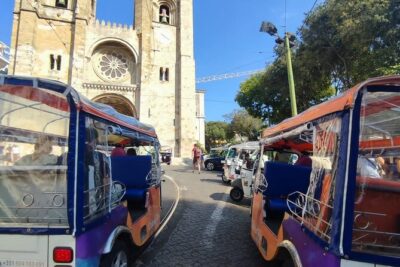
Lisbon Highlights: Private Tuk Tuk Tour Adventure Sightseeing
Read our review →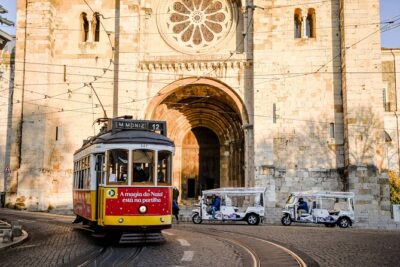
Welcome Lisbon Tour with Local Guide in Private Eco Tuk Tuk
Read our review →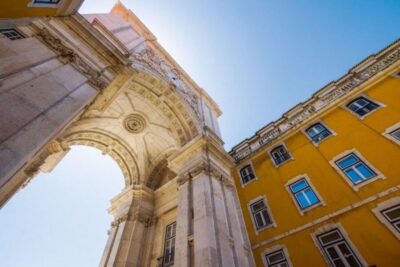

Old Town TukTuk Tour and Scenic Viewpoints in Alfama
Read our review →