
Review · BERLIN
Rickshaw for 2 and Driver-Shared Guide (Combo Vehicle Group)
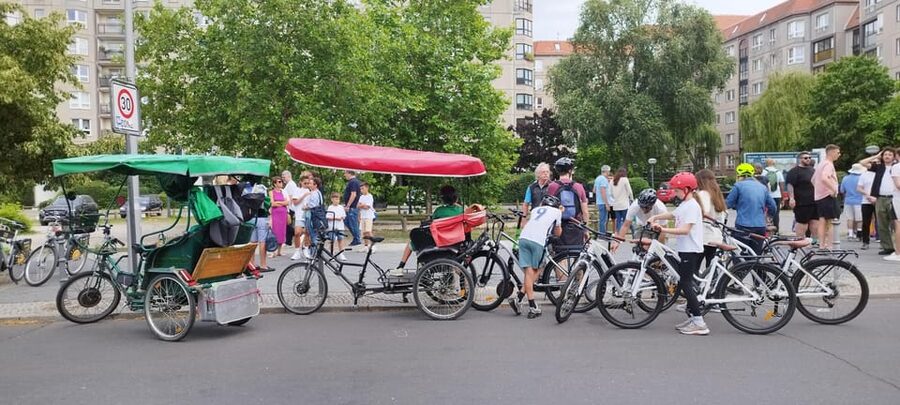
Berlin’s historic center is spread across a surprisingly large area, and this three-and-a-half-hour combo tour covers it without asking everyone to walk from monument to monument. You can pedal an e-bike, ride an e-scooter, or sit back in a traditional rickshaw while the group moves from Alexanderplatz to the Brandenburg Gate and the Cold War sites around Checkpoint Charlie.
I like two things right away: the rickshaw option keeps mixed-ability families together, and the guide adds personal stories rather than simply pointing at buildings. A verified French-language booking praised the guide’s spontaneous style and memorable anecdotes, which is exactly what can turn a long list of sights into a living portrait of Berlin.
The main point to check is the meeting information. The tour description gives Weinbergsweg 6 as the meeting and return point, while another section mentions Torstrasse 85 and a 10:00 AM gathering. Confirm the exact location and start time before setting out.
Key points to know before booking
- A practical way to cross Berlin Mitte: The route links Alexanderplatz, Museum Island, Unter den Linden, the Reichstag, the Holocaust Memorial, Checkpoint Charlie, and other central sights in one outing.
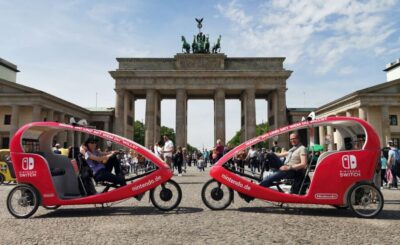
- A true mixed-vehicle tour: Two people can ride in a rickshaw while others in the group use e-bikes or e-scooters.
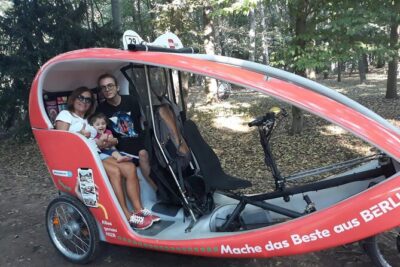
- Good for different ages and abilities: Sitting in the rickshaw can make the day easier for grandparents, young children, or anyone who prefers not to cycle.
- Small group size: The experience is limited to eight participants, so the guide can keep the group together at city crossings and busy stops.
- A guide-led history lesson: Expect stories about German politics, Prussian Berlin, Nazi crimes, the Berlin Wall, and the city’s modern culture.
- Useful booking flexibility: Cancellation is free up to 24 hours before the tour, and you can reserve now and pay later.
Why a rickshaw works well in Berlin Mitte
Berlin Mitte is not a compact old town where every major sight sits around one square. The landmarks are spread along broad avenues, open plazas, former government districts, and memorial sites. Walking between them can take much of a morning, while a car would miss the feel of the streets and public spaces.
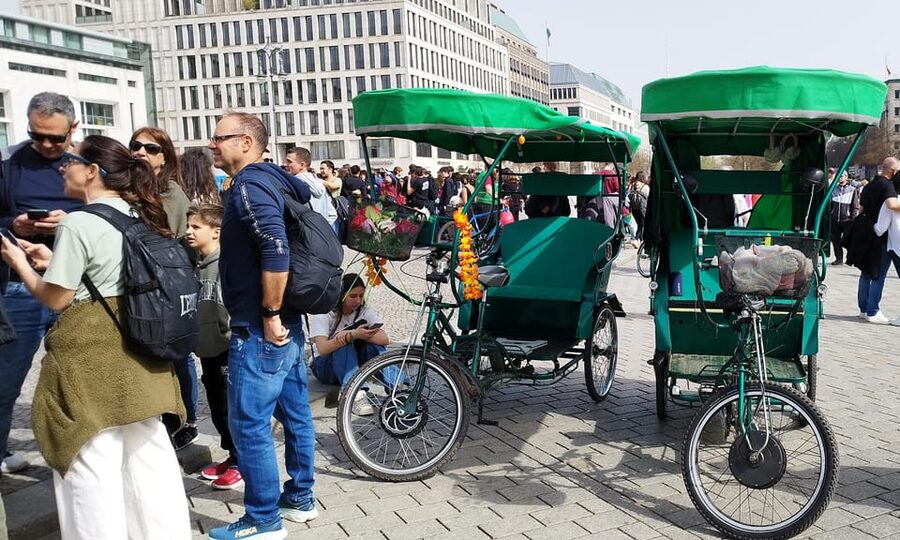
The rickshaw fills that gap nicely. You can sit comfortably, keep your eyes on the buildings, and listen as the guide explains what happened there. It is especially useful when one person in your party is not a cyclist or simply wants a gentler day.
This is also a sensible choice for a family group with different energy levels. The listed arrangement allows rickshaws, e-bikes, and e-scooters to share one guided route. That means you do not have to split up because one person cannot ride.
The route is not a private chauffeur service. It is a small shared group, limited to eight people, and the experience is designed around moving together. If you want a completely private schedule or long visits inside museums, this is not the right format. If you want a broad first look at central Berlin, it makes good use of the time.
More Rickshaw Tours in Germany
- Berlin: Private Guided E-Rickshaw Tour
★ 4.9 · 157 reviews - Individual City Tour – Rickshaw Sightseeing in Berlin
★ 5.0 · 120 reviews - Berlin Express: Private 1-Hour E-Rickshaw Ride
★ 5.0 · 116 reviews
Starting near Rosenthaler Platz
The stated meeting point is Weinbergsweg 6, near U-Bahn Rosenthaler Platz. This puts you in a lively part of Mitte, close to cafes, bars, small shops, street art, and Weinbergspark.
The area is a useful place to begin because it feels like present-day Berlin rather than a formal monument district. Weinbergspark offers a quiet green pause nearby, though the tour itself is focused on sightseeing rather than spending time in the park.
There is a small practical wrinkle. The description also refers to Torstrasse 85 as the daily meeting location and says groups gather at 10:00 AM. Since the itinerary lists Weinbergsweg 6 as both the start and finish, verify the meeting address and departure time when you book.
The experience lasts 210 minutes. That is enough for a brisk sweep of the main sites, with photo stops and guide commentary, but not enough for lengthy interior visits. Think of it as a moving history tour with stops, not a museum tour.
Alexanderplatz, the TV Tower, and Rotes Rathaus
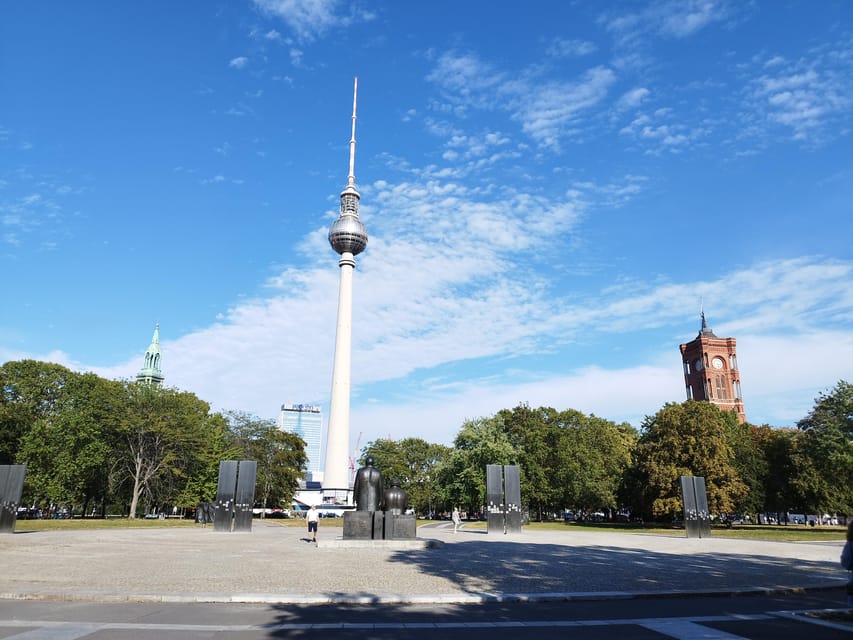
The route begins in the area of Alexanderplatz, where the Fernsehturm, or TV Tower, quickly gives you one of Berlin’s most recognizable sights. The tower’s tall, needle-like profile helps you understand the scale of the city and gives the opening section a strong visual marker.
You stop for photos and hear about the area from the guide. The itinerary also includes Rotes Rathaus, Berlin’s red-brick town hall. These first stops introduce two sides of the city: the monumental modernist character of Alexanderplatz and the civic traditions represented by the town hall.
This section is best for orientation rather than quiet reflection. Alexanderplatz can feel open and busy, and the tour will not provide time to go up the TV Tower. You see it as part of the city’s skyline and hear its place in Berlin’s story.
Museum Island, the cathedral, and Unter den Linden
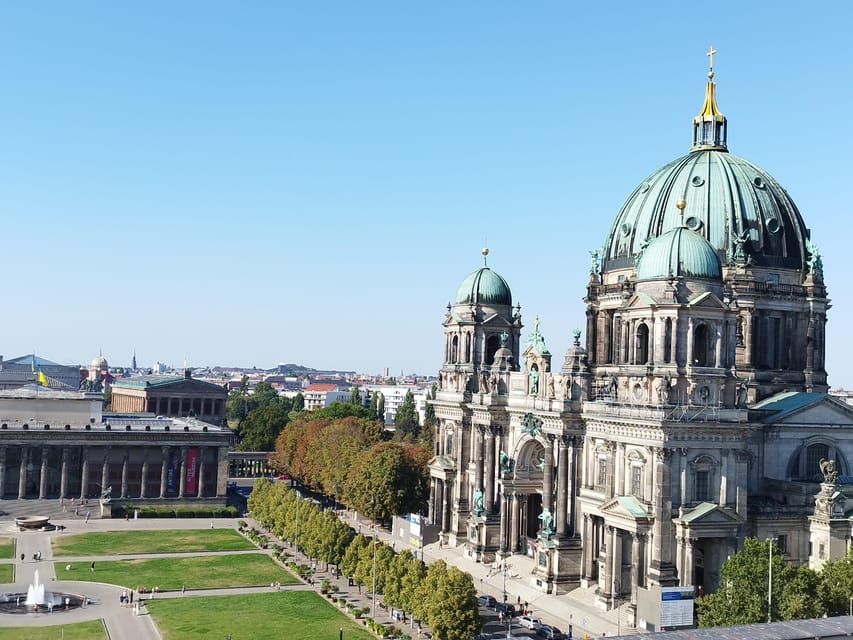
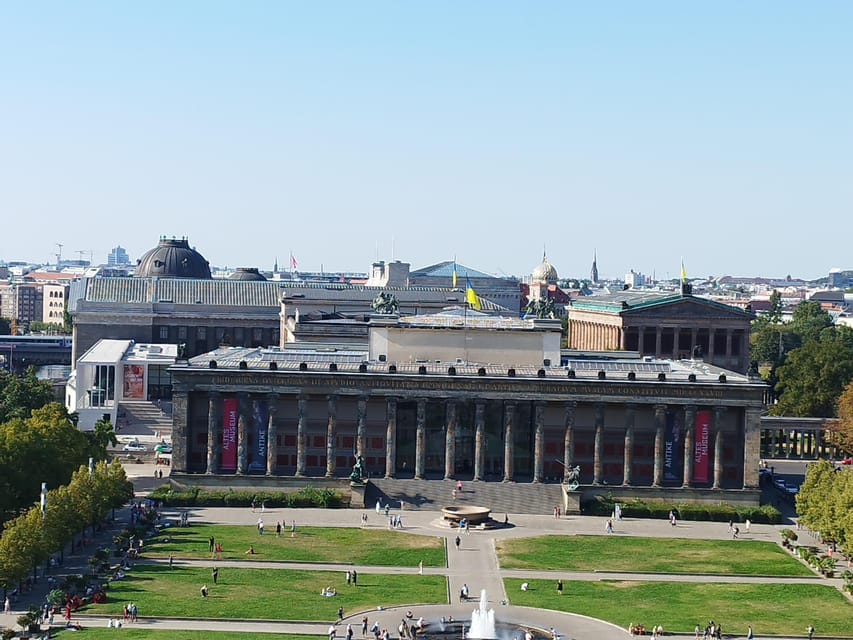
From there, the route moves toward Museum Island, the cultural center of Berlin’s old core. The island is home to major museums, but this experience focuses on exterior views and explanations rather than museum entry.
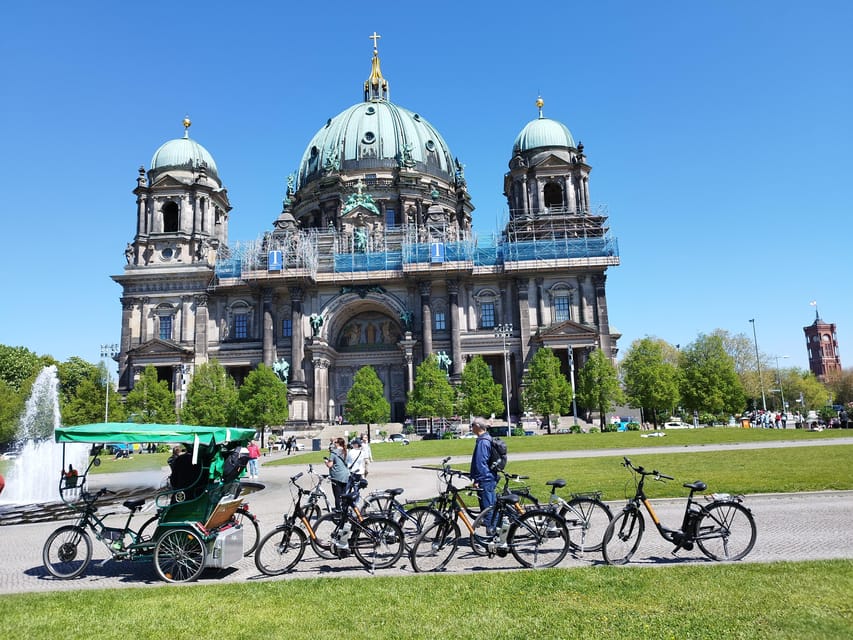
Berlin Cathedral is one of the most striking buildings on the route. Its grand dome and riverside setting make it an easy photo stop, while the nearby Altes Museum adds another layer of Berlin’s royal and cultural past. The guide connects these buildings with the wider story of the city’s public squares, institutions, and former royal center.
Unter den Linden provides a long view through Berlin’s formal heart. This major avenue links the cathedral and Museum Island area with the Brandenburg Gate. Along the way, you see the Opera House, Neue Wache, Bebelplatz, and other important buildings.
The route description labels Unter den Linden with an overnight-stay note, which does not fit a 210-minute daytime tour. Treat that as a scheduling error rather than an overnight component. The stated experience is a same-day guided outing that returns to Weinbergsweg 6.
More Rickshaw Tours in Berlin:
- Rickshaw Tours Berlin – Groups of up to 16 people with several rickshaws
★ 4.0 · 97 reviews - Rickshaw Sightseeing City Tours Berlin – Rikscha Tours
★ 4.0 · 55 reviews - Berlin: Private Sightseeing Tour in an E-Rickshaw
★ 4.9 · 44 reviews - One Up to 3 Rickshaws(6 GUESTS)-Taylor Made Rickshaw Berlin Tour
★ 5.0 · 20 reviews
Brandenburg Gate and the Reichstag
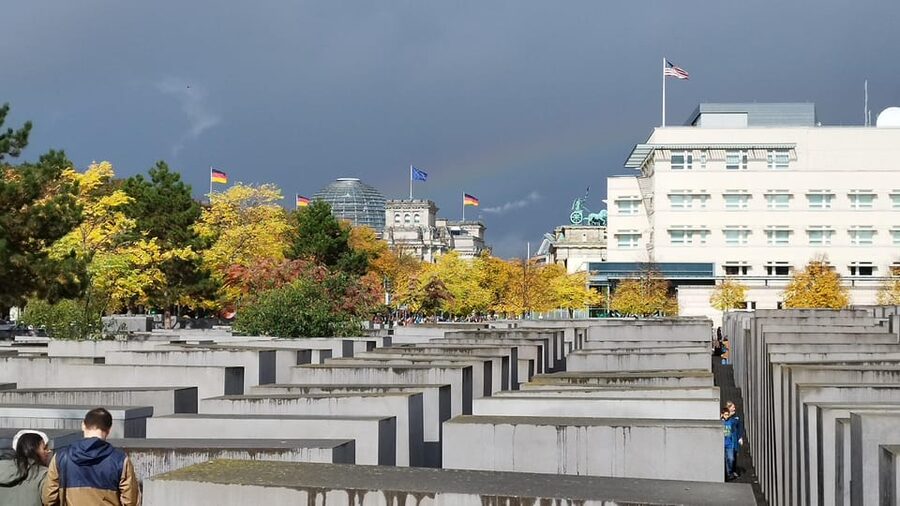
The Brandenburg Gate is one of the tour’s essential stops. It has served as a symbol of Berlin, German power, division, and reunification, so the guide’s explanation matters as much as the photo opportunity.
Nearby, the Reichstag and Bundestag bring the story into present-day German politics. You can expect a guided exterior visit and scenic views, not a parliamentary interior tour. The route gives you a sense of how close the main political buildings are to the historic center’s memorials and former government sites.
The embassies of the United States and France are also included in the wider tour coverage. These diplomatic buildings help explain why this part of Berlin remains a working political district, not just a collection of monuments.
A rickshaw is useful here because the open spaces around the gate and government quarter can involve more walking than the map suggests. You can focus on the guide’s explanation instead of spending your energy crossing the whole district.
The Holocaust Memorial and Hitler’s bunker site
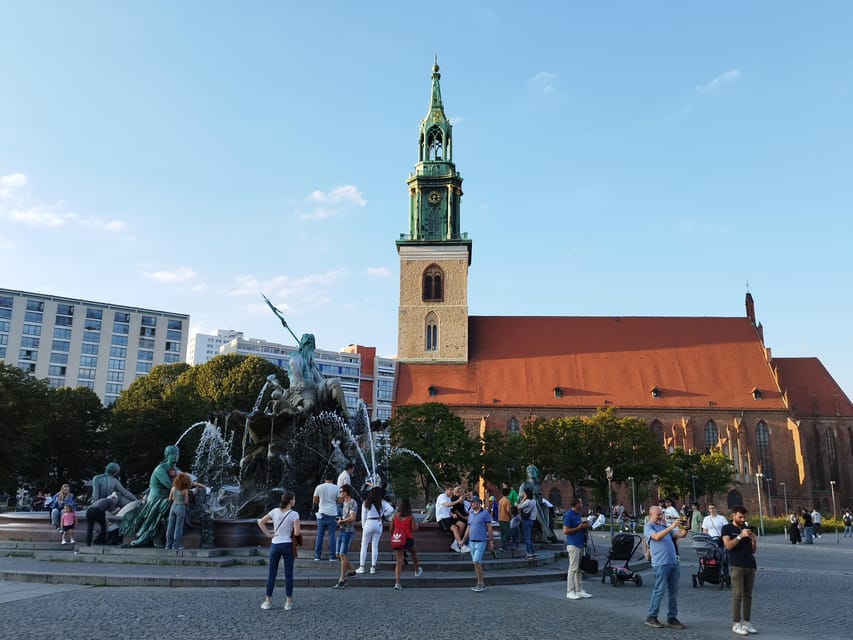
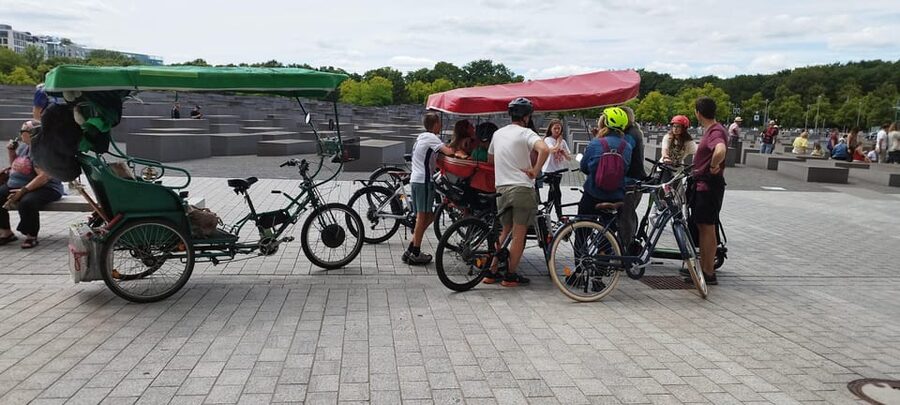
The Holocaust Memorial is one of the most serious stops. Its field of concrete blocks is intended as a place for thought and remembrance, not a quick photo backdrop. The guide provides historical context, but you should allow yourself a quiet moment to take in the site.
The route also points out the location of Hitler’s bunker. There is no visible bunker interior to visit here. The value is in understanding the site’s place in the final days of Nazi Germany and in seeing how an ordinary-looking part of Berlin can conceal a major historical event.
These stops require a respectful attitude. The tour moves at a steady pace, so you may not have long periods alone at either location. Still, having a guide explain the setting can help you connect the memorial and bunker site with the larger story of dictatorship, war, and the destruction of Berlin.
Potsdamer Platz and the Topography of Terror
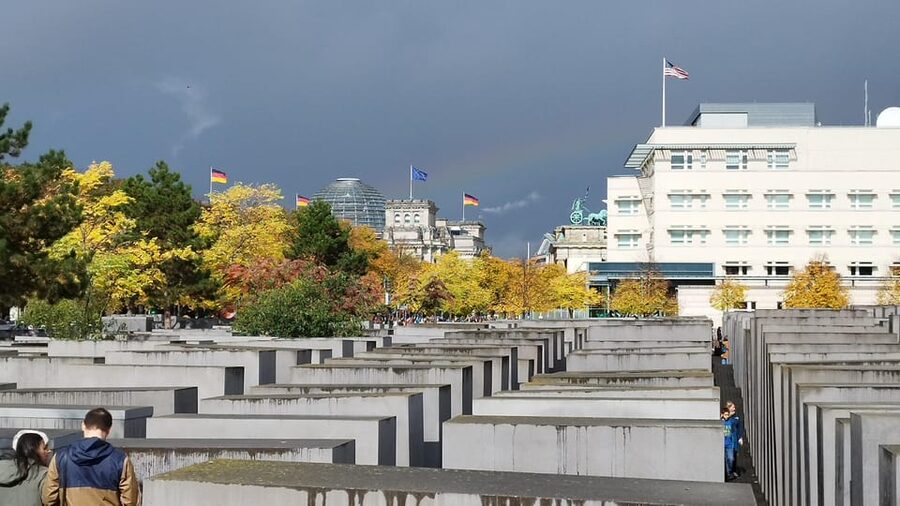
The itinerary includes ministerial gardens and Potsdamer Platz, where contemporary architecture sits near places shaped by twentieth-century conflict. Potsdamer Platz is a useful reminder that Berlin is not frozen in its past. It has been rebuilt, reshaped, and filled with new offices, shops, and public spaces.
The Topography of Terror shifts the focus back to Nazi rule. The site documents the institutions and crimes of the SS and Gestapo. On this tour, you should expect an exterior stop and a spoken introduction rather than time for a full visit through the documentation center.
That distinction matters. If you want to study the Topography of Terror in detail, plan a separate visit. The rickshaw tour gives you the map and the historical framework, then carries you onward to the next part of the city.
The Berlin Wall and Checkpoint Charlie
The Cold War section includes remnants and stories connected with the Berlin Wall and Checkpoint Charlie. These places can feel more spread out than first-time visitors expect, so traveling between them saves time.
Checkpoint Charlie is one of Berlin’s best-known Cold War locations. The guide explains how it functioned as a crossing point and why it became a symbol of the divided city. The tour also includes Berlin Wall history and visible remnants or related sites along the route.
There is a risk of expecting a preserved border crossing exactly as it looked before 1989. Much of central Berlin has changed, and some displays around Checkpoint Charlie are modern or commercial in tone. A good guide helps separate the genuine historical setting from the later layers of tourism.
This is where the guide’s anecdotal style can be particularly useful. The route is full of dates and political facts, but personal stories and small details make the Wall’s impact easier to grasp.
Gendarmenmarkt and Bebelplatz
Gendarmenmarkt is one of Berlin’s grandest squares, framed by major historic buildings. It gives the tour a change of mood after the difficult Nazi and Cold War sites. The square’s scale, symmetry, and architecture show Berlin’s formal side.
Bebelplatz carries a much more painful memory. It is associated with the Nazi book burning of May 10, 1933, and the memorial there asks you to think about censorship, intimidation, and the destruction of ideas.
The route includes the Opera House and the avenue of Unter den Linden as part of this section. You get a useful contrast between cultural institutions that survived or were rebuilt and the political violence that scarred them.
Since the tour has many stops, the guide cannot give every building a long explanation. If one site catches your interest, note it down for a later visit. That is one of the best uses of a city overview tour: it helps you choose where to return.
What the guide adds to the ride
The guide is described as local, certified under DIN EN 15565, and able to lead tours in Dutch, English, German, and Turkish. The emphasis is on Berlin’s politics, architecture, art, culture, and changing identity.
The strongest clue about the guiding style comes from the French-language booking note praising a spontaneous approach and plenty of anecdotes. That suggests you should expect more than a memorized list of dates. The best moments may come when the guide links a building to a personal story, an unusual detail, or a change in Berlin’s daily life.
Because the tour is shared, ask questions when the group pauses. The small size, capped at eight people, should make that easier than on a large coach tour. Still, a moving city tour has limits, and the amount of conversation may depend on the group and the traffic conditions.
Water and soft drinks are provided. Alcohol is not allowed for people riding e-bikes or e-scooters during the tour. People seated in the rickshaw may have beer or sparkling wine while riding, according to the tour information, though drinking is not the main reason to choose this experience.
Is $235 good value for two people?
The listed price is $235 per group of up to two, not per person. For a couple, that works out to $117.50 each before considering the value of the vehicle, guide, drinks, and 210 minutes of touring.
That is not a cheap way to see Berlin, but it is easier to justify if you need a rickshaw or want a private two-person vehicle within a shared guided group. The price also makes more sense for a couple who would otherwise need taxis, separate rentals, or several public transport connections to cover the same circuit.
For independent cyclists, the value is less obvious. You could cover some of these districts at a lower cost on your own, though you would give up the guide’s historical explanations and the convenience of a planned route.
The strongest value comes from access and time saved. If one person cannot cycle, if your family includes young children, or if long walks are difficult, the rickshaw allows you to see the center without turning the day into an endurance test.
Who should book this Berlin tour?
I would choose this experience for a couple or small family that wants a broad introduction to Berlin before deciding what deserves a longer visit. It is especially well suited to grandparents, young children, mixed-ability groups, and anyone who wants to sit rather than pedal.
It also works for first-time visitors who want the major political, royal, Nazi, and Cold War sites tied together by a single guide. The four-hour format gives you a useful mental map of Mitte.
I would not choose it if your main goal is entering museums, climbing the TV Tower, touring the Reichstag interior, or spending a long time at the Topography of Terror. You will see these places from the route, hear their stories, and take photos, but the schedule is built for breadth.
Before booking, confirm the meeting point because Weinbergsweg 6 and Torstrasse 85 both appear in the information. Then choose the rickshaw if comfort and inclusion matter most. At $235 for two, it is a fair practical choice when the alternative is splitting up or tiring out part of your group.
FAQ
How long does the Berlin rickshaw tour last?
The tour lasts 210 minutes, or three and a half hours.
What is the price for the experience?
The listed price is $235 per group of up to two people.
Where does the tour meet?
The itinerary gives Weinbergsweg 6 as the starting and return point, near U-Bahn Rosenthaler Platz. The tour information also mentions Torstrasse 85, so confirm the exact meeting location before departure.
What languages does the guide speak?
The live guide is available in Dutch, English, German, and Turkish.
How many people are in the group?
The experience is limited to eight participants.
Which major Berlin sights are included?
The route includes the TV Tower, Rotes Rathaus, Museum Island, Berlin Cathedral, Unter den Linden, Brandenburg Gate, Reichstag, Holocaust Memorial, Hitler’s bunker site, Topography of Terror, Berlin Wall sites, Checkpoint Charlie, Gendarmenmarkt, and the Bebelplatz book-burning memorial.
Can people with limited mobility take part?
Yes. The traditional rickshaw is intended for people who prefer not to cycle, including grandparents, young children, and people with limited mobility. It lets the group travel together while others use e-bikes or e-scooters.
More Private Drivers in Berlin
- 2-Hour TukTuk Rental with an Experienced Guide and Driver
★ 4.5 · 237 reviews - Angkor Wat Private Tour by Tuk-Tuk with English Speaking Driver
★ 5.0 · 142 reviews - Private Udaipur Sightseeing Tour by Tuk-Tuk or Car with Driver
★ 5.0 · 112 reviews - Angkor Wat Tour by Tuk-Tuk with English Speaking Driver
★ 4.5 · 65 reviews
Just added around Berlin
- One Up to 3 Rickshaws(6 GUESTS)-Taylor Made Rickshaw Berlin Tour★ 5.0 · 20 reviews
- Romantic Berlin Rickshaw City and Photo Tour – incl. pick-up★ 4.0 · 9 reviews
- Rickshaw Sightseeing Tours Berlin – Highlights Berlin – Rickshaw city tour★ 3.5 · 3 reviews
- Rickshaw Tour-Cruise Ship guests arrive 9.30 upto 11.30 am Berlin★ 5.0 · 7 reviews
- Daily First Rickshaw promotion in Combi Vehicle public Group 90€★ 5.0 · 11 reviews
- Rickshaw Sightseeing City Tours Berlin – Rikscha Tours★ 4.0 · 55 reviews
- Private Up to 12 Guests-ONE RICKSHAW, E-Bikes, E-Scooters★ 5.0 · 2 reviews
- Private Guide Up to Group 6 – ONE Rickshaw, (E)Bikes, E-Scooters★ 5.0 · 3 reviews
Berlin Tuk Tuk Tours, compared.
Individual City Tour – Rickshaw Sightseeing in Berlin
Read our review →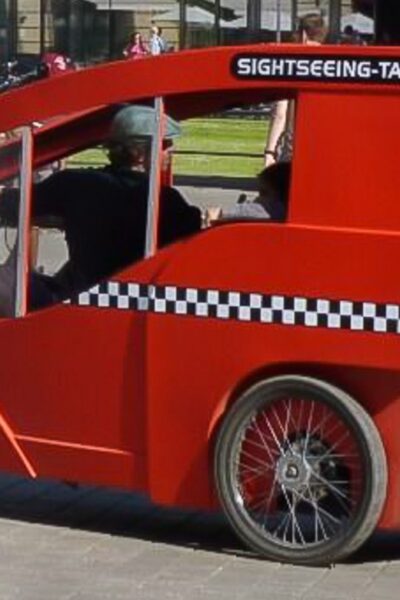

Rickshaw Tours Berlin – Groups of up to 16 people with several rickshaws
Read our review →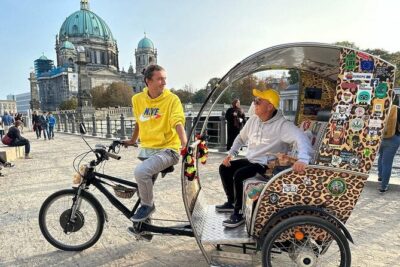
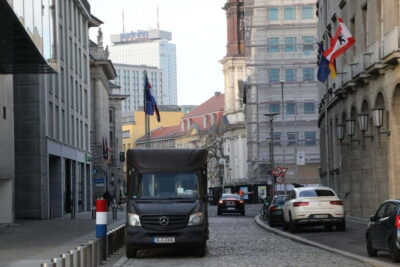
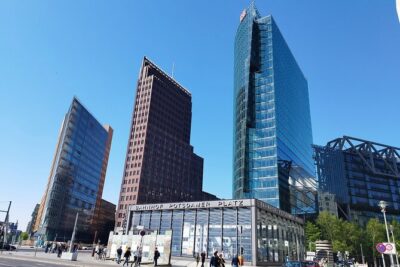
One Up to 3 Rickshaws(6 GUESTS)-Taylor Made Rickshaw Berlin Tour
Read our review →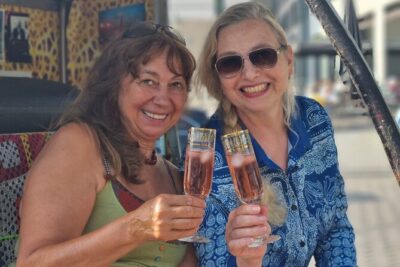
Berlin Rickshaw Tours Historical & Photo City Tour 120min – Sightseeing
Read our review →Browse the lists this tour appears in