
Review · KYOTO
Kyoto Rickshaw Tour
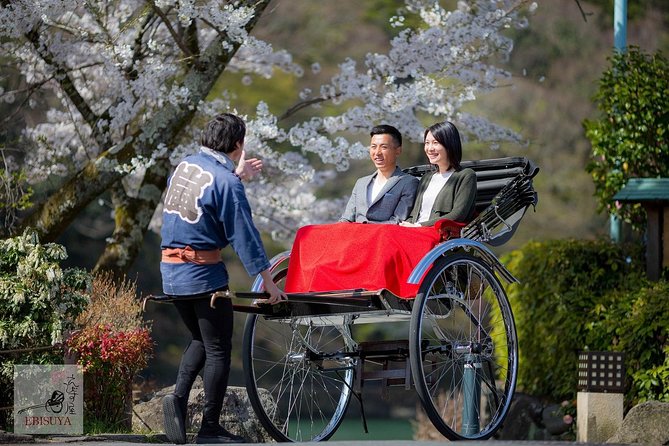
Kyoto’s old streets make far more sense from a rickshaw seat. You glide through narrow stone lanes and past wooden townhouses while your driver handles the hills, traffic, and route. I especially like the private format and the chance to tailor the ride, plus the guides’ knack for taking photos and explaining local customs. The main catch is the narrow seat, only 29.1 inches wide, so two adults may feel cramped.
I also like how much this helps if walking is hard. A two-hour ride can cover temples, shrines, Gion, and tucked-away streets without asking you to cross the whole district on foot. Guides such as Fumi, Kai, Yoshi, Kanta, Kota, and Hina have been praised for strong English, humor, and local stories, though shorter tours cannot cover every listed stop.
Key points to know before booking
- A private ride through Higashiyama and Gion: Your group rides alone with an English-speaking driver-guide.
- Flexible timing from 30 minutes to 3 hours: Longer options allow time for more streets, shrines, temples, and photo stops.
- A narrow 29.1-inch seat: Two adults fit, but separate rickshaws may be more comfortable.
- Strong photo help from the guides: Drivers regularly stop to take pictures of you and your group.
- Arashiyama is not part of this booking: The voucher is valid only at the Higashiyama branch.
- A good choice for limited mobility: You can see much of old Kyoto while seated, though boarding and getting in and out still require care.
Why a rickshaw works so well in old Kyoto
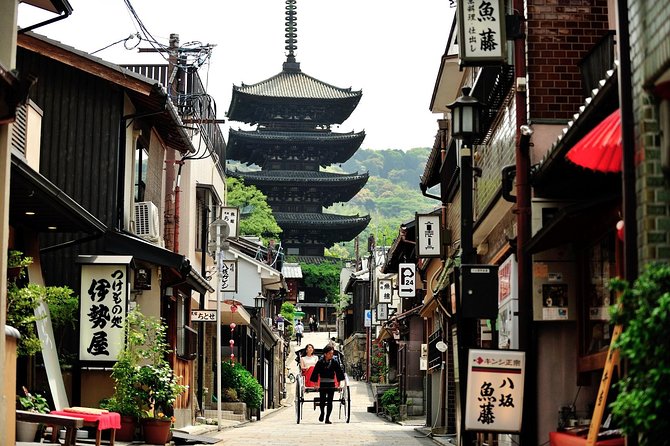
The best part of this ride is not speed. It is access. A rickshaw can slip along the old cobblestone streets of Higashiyama while you sit high enough to see wooden facades, tiled roofs, temple gates, and passing life around you.
Walking Kyoto is rewarding, but it can also be tiring. The streets around Gion and Higashiyama rise and fall, and the most attractive lanes are often crowded or uneven. A rickshaw lets you cover more ground without turning the day into a march. You still get out for selected stops, but the driver carries the hard part.
I see this as an especially good first introduction to Kyoto. Your guide can point out the difference between Buddhist temples and Shinto shrines, explain customs, and help you understand why certain streets look as they do. Guides including Fumi, Kai, Yoshi, Kanta, and Kota are praised for their English and easy conversation. That matters here because the value comes from the running commentary, not just the ride.
The service is private, so you do not share the rickshaw with strangers. That gives you room to ask questions and request a slower pace or a route shaped around temples, photography, architecture, or the geisha district.
More Rickshaw Tours in Japan
- Tokyo Asakusa Rickshaw Tour
★ 5.0 · 1,375 reviews - Kyoto: Arashiyama Customized Rickshaw Tour & Bamboo Forest
★ 5.0 · 432 reviews - Kyoto Arashiyama Rickshaw Tour with Bamboo Forest
★ 5.0 · 354 reviews
Higashiyama streets, wooden houses, and old Kyoto atmosphere
The starting point is Ebisuya Higashiyama Rickshaw at 483 Shimokawaracho, in Kyoto’s Higashiyama Ward. It is near public transportation, and the ride ends back at the same stand unless you arrange another finishing point.
Once underway, expect narrow lanes and traditional wooden buildings rather than broad city streets. The old roads are part of the appeal. You can look closely at shopfronts, stone walls, entrances, and the compact architecture that gives this part of Kyoto its character.
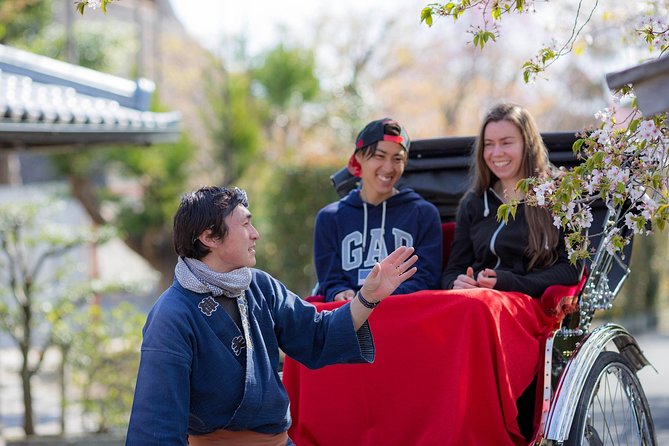
The driver usually keeps the ride moving, then stops where you can take pictures or walk a short distance. Several guides are praised for photography, including taking both posed pictures and quick shots during the outing. That is useful because you can enjoy the ride without constantly holding up your phone.
The short 30-minute option is best viewed as a taste of the area. It can give you a pleasant ride through Gion or Higashiyama, but it will not allow time for every temple, shrine, and district listed in the longer route. If you want history, photos, and several stops, I would look first at the 70-minute or two-hour choices.
Gion and the geisha district
Gion is one of the strongest reasons to book this particular branch. The route can pass through a traditional geisha district filled with wooden townhouses and carefully preserved streets. You may spot a geisha or maiko, but that should be treated as luck, not a promise.
The rickshaw is a useful way to see this area because you can cover several streets while your guide explains the customs and history behind them. A guide may also take you along quieter paths that are easy to miss when you are following the main pedestrian flow.
Keep your expectations respectful. This is a working neighborhood, not a stage set. Your driver can help you understand what you are seeing, but the ride is not an invitation to chase or photograph people at close range.
A 70-minute route gives you a better balance here. It is long enough to see a good section of Gion and stop for pictures without committing to a half-day activity. One guide, Shuhei, was praised for a 70-minute Higashiyama ride that included Buddhist temples and Shinto shrines around Gion. That mix gives you a clearer sense of how different parts of Kyoto’s religious life sit side by side.
Bridges, gardens, and temple stops
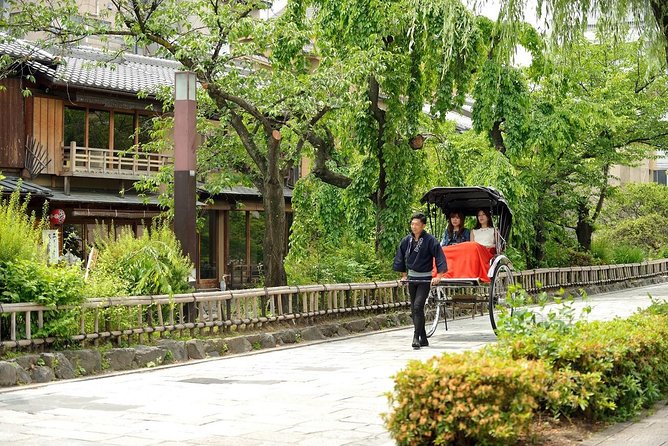
The route can include a small bridge in a traditional district, a beautiful temple with a garden, and a larger, more imposing temple. Exact stops depend on the length of your booking and the route you agree on with the guide.
The garden temple is likely to appeal most if you enjoy quiet views and carefully arranged spaces. The larger temple gives you more scale and ceremony. These stops help break up the ride, since you are not simply passing sights from the seat.
Some participants have added a temple visit, such as Kennin-ji, for an extra charge. That is not automatically included, so ask before departure if a specific temple matters to you. A shorter ride may pass the area without allowing enough time to enter.
The small bridge and older lanes offer a different kind of appeal. They are less about checking off a major monument and more about seeing how Kyoto’s traditional neighborhoods fit together. I would tell your guide if you prefer architectural details, gardens, shrines, or quiet lanes. The tour can be customized, but you need to discuss your priorities early.
Same streets, a different route:
- Tokyo: Asakusa Sightseeing Tour by Rickshaw
★ 4.9 · 195 reviews - Kyoto: Private Rickshaw Tour of Gion and Higashiyama Area
★ 5.0 · 144 reviews - Otaru Rickshaw Tour
★ 5.0 · 76 reviews - Kamakura Rickshaw Tour
★ 5.0 · 53 reviews
Yasaka Shrine and the best timing for a visit
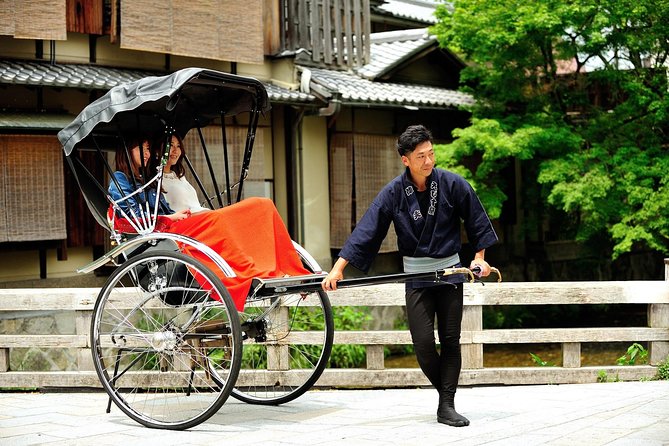
The route can include a large shrine in the Gion area, Yasaka Shrine. It is worth visiting on its own, and the information provided specifically points to New Year as a special time to go, either before or after the rickshaw ride.
That timing advice is practical. If you want to visit during New Year, the shrine can be a major part of your Kyoto plans. You may prefer to use the rickshaw for the surrounding streets and then explore the shrine separately, or arrange your day in the opposite order.
Do not assume every listed landmark fits into a 30-minute booking. The tour operator makes clear that shorter options cannot cover all stops. If Yasaka Shrine, a temple garden, and the geisha district are all priorities, choose a longer ride and confirm the plan with the guide.
What the 30-minute, 70-minute, two-hour, and three-hour options mean
The advertised price starts at $39.79 per person, but the exact cost depends on the option you select. That starting price can be good value for a private introduction, especially if you want orientation rather than a full sightseeing day.
Here is how I would think about the time choices:
- 30 minutes: A quick taste of Gion or Higashiyama. Good for children, tight schedules, or anyone unsure about the idea. Expect a limited route.
- 70 minutes: The most balanced choice for many people. You have time for old streets, a few landmarks, explanations, and photos without using half a day.
- Two hours: Better if you want several temples, shrines, the geisha district, and more time for questions. It also gives the guide room to adapt the route.
- Three hours: The broadest Higashiyama experience. This suits first-time visitors who want a relaxed introduction or anyone who prefers a seated way to cover more ground.
The value improves with the longer rides if you plan to use the guide actively. Ask questions, request photo stops, and state your priorities. If you simply sit through a short loop, you are paying mainly for transport and atmosphere. If you use the guide as a local interpreter, the ride becomes a compact Kyoto orientation.
Comfort, seating, and family details
Each rickshaw is 74 centimeters wide, or 29.1 inches. Two adults can ride together, but that does not mean two adults will find it comfortable. If you are broad-shouldered, tall, or simply want more space, book one rickshaw per person.
This point is easy to miss and important to get right. If two people do not fit comfortably in one rickshaw, you may need to purchase another one. An extra rickshaw with an English-speaking guide may not be available on the day if you wait until arrival.
A maximum of two adults can ride in one rickshaw. Children aged five and under may sit on an adult’s lap, with one child per adult. Up to two young children can ride with two adults, but a child using one of the two seats must be booked as an adult. Adult pricing applies from age six.
The ride may suit someone who cannot walk long distances. One participant who unexpectedly needed a wheelchair found the rickshaw a useful way to see Kyoto, and the two-hour route covered a great deal. Still, this is not a fully wheelchair-accessible sightseeing vehicle. You need to manage getting into the rickshaw and sitting during the ride, so discuss your needs in advance.
The guides make or break the experience
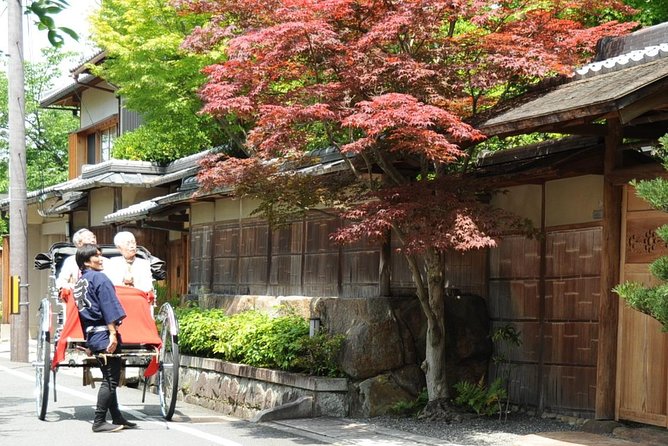
The drivers do far more than pull the vehicle. They guide, explain, answer questions, choose the route, and often take photos. That combination is why the experience can feel personal rather than mechanical.
Names that have received especially warm praise include Fumi, Kai, Yoshi, Kanta, Kota, Hina, Daichi, Shuhei, Moto, and Fuji. Their strengths differ, but the common themes are clear: good English, humor, fitness, patience, and a strong feel for Kyoto’s old districts.
The physical work is real. The route can include hills, and the driver is doing that work while speaking with you in a second language. It is worth showing basic courtesy and allowing the guide to set a safe pace.
You can also use the guide for practical help. Ask about shrine customs, local folklore, temple design, or the best place to finish for lunch. One group arranged a drop-off at a rickshaw cafe for brunch, though finishing somewhere other than the stand may bring an extra fee payable that day.
What is not included, and what often causes confusion
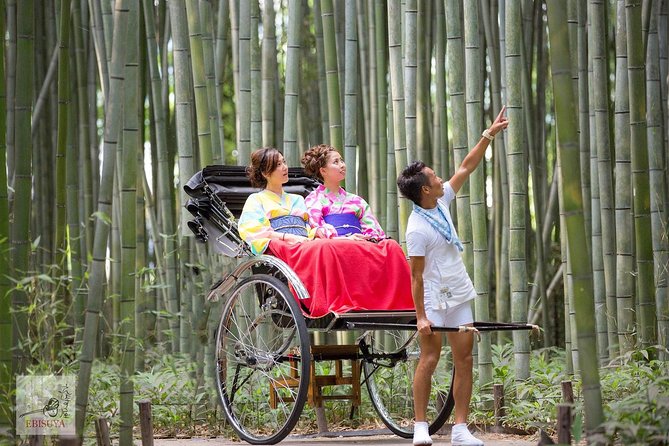
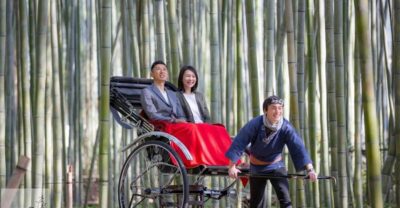
This is the Higashiyama branch, not the Arashiyama branch. The Arashiyama Bamboo Forest is not included, and the voucher cannot be used at the Arashiyama location. If the bamboo forest is your main goal, this is the wrong booking.
Hotel pickup and drop-off are not included. Food and drinks are also not part of the price. You meet at the Higashiyama stand and normally return there at the end.
The ride operates in poor weather conditions according to the tour information, yet the cancellation terms also allow a different date or full refund if the activity is canceled because of poor weather. Bring suitable clothing and confirm the day’s arrangements if the forecast looks severe.
Arrive early. Any delay is taken from your tour time, and being 10 minutes or more late results in automatic cancellation. Changes or rescheduling requests sent after 5 p.m. the day before cannot be accepted.
Who should book this Kyoto rickshaw ride
I would choose it for a first visit, a special family outing, or a day when walking needs to be limited. It is also a good match if you want photos without asking a companion to keep taking them, or if you enjoy asking detailed questions about customs and local history.
The ride works well for couples because the old lanes and gardens feel intimate. Families may like the novelty and the short time options. Older adults can see much of Higashiyama without covering every street on foot.
I would think twice if you dislike confined seating, want complete control over your pace, or plan to see Arashiyama. A rickshaw is not the cheapest way to move around Kyoto, and you will still need to walk at stops. The experience earns its price through the guide, access to old lanes, and the pleasure of seeing Kyoto from a different height.
Should you book it?
Yes, if you want an easy and memorable introduction to Gion and Higashiyama, especially on your first Kyoto visit. I would lean toward 70 minutes for a well-rounded taste, two hours for temples and questions, and three hours only if you want the ride to be a major part of your day.
Book separate rickshaws for adults who may find 29.1 inches too narrow. Confirm the route if a certain temple or shrine matters, and do not book this expecting the Arashiyama Bamboo Forest.
The 4.9 rating from 210 reviews and 98 percent recommendation fit the strongest parts of the experience: warm guides, excellent photos, flexible routes, and a practical way to see old Kyoto. Just treat the seat size, punctuality rules, weather terms, and branch location as part of the decision.
FAQ
Where does the Kyoto Rickshaw Tour start and finish?
It starts at Ebisuya Higashiyama Rickshaw, 483 Shimokawaracho, Higashiyama Ward, Kyoto, 605-0825, Japan. The activity normally ends back at the same meeting point.
How long does the rickshaw tour last?
Available options range from approximately 30 minutes to 3 hours. Not every landmark can be covered on the shorter options.
What is included in the price?
The booking includes the rickshaw ride and a local English-speaking guide.
Is hotel pickup included?
No. Hotel pickup and drop-off are not included. You meet at the Higashiyama rickshaw stand.
Does this tour include Arashiyama Bamboo Forest?
No. Arashiyama Bamboo Forest is not included. The voucher is valid only at the Kyoto Higashiyama branch, not the Arashiyama branch.
How many adults can ride in one rickshaw?
A maximum of two adults can ride in one rickshaw. Each vehicle is 29.1 inches, or 74 centimeters, wide, so separate rickshaws may be more comfortable.
Can young children ride?
Children aged five and under may sit on an adult’s lap, with one child per adult. Up to two children aged five and under can ride with two adults. A child using one of the two seats must be booked as an adult.
What happens if I am late or need to cancel?
A delay reduces your tour time, and being 10 minutes or more late results in automatic cancellation. You can cancel for a full refund up to 24 hours before the start time. Changes made less than 24 hours before the tour are not accepted.
Just added around Japan
- Sushi Making Tokyo with Traditional Rickshaw Ride Tour in Asakusa★ 5.0 · 12 reviews
- Exiting Rickshaw ride and Kimono experience★ 5.0 · 4 reviews
- Hot Spring Capital of Yufuin Rickshaw Tour★ 5.0 · 32 reviews
- Kyoto Sagano Insider: Rickshaw and Walking Tour★ 5.0 · 15 reviews
- Kurashiki Rickshaw Tour★ 5.0 · 39 reviews
- Private 3-hour Kyoto Arashiyama Rickshaw Tour★ 5.0 · 5 reviews
- Kamakura Rickshaw Tour★ 5.0 · 53 reviews
- Rickshaw Tour of Kagoshima’s Historical and Cultural Sites★ 5.0 · 4 reviews
Kyoto Tuk Tuk Tours, compared.
Arashiyama Customized Rickshaw Tour & Bamboo Forest
Read our review →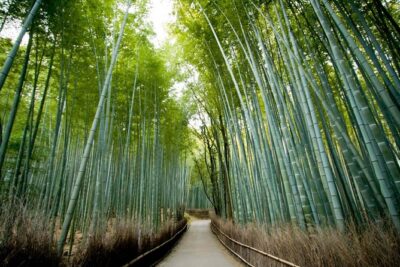
Kyoto Arashiyama Rickshaw Tour with Bamboo Forest
Read our review →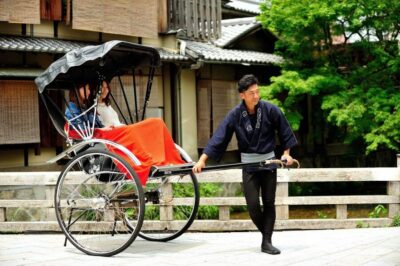
Private Rickshaw Tour of Gion and Higashiyama Area
Read our review →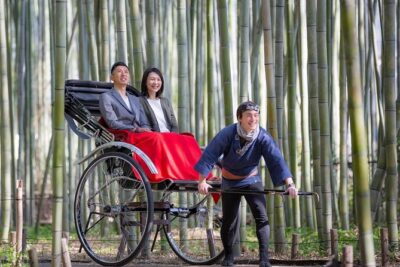
Kyoto Sagano Insider: Rickshaw and Walking Tour
Read our review →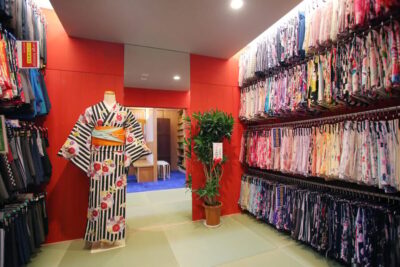
Kiyomizu-dera Temple Rent a kimono and ride a rickshaw
Read our review →
Browse the lists this tour appears in